



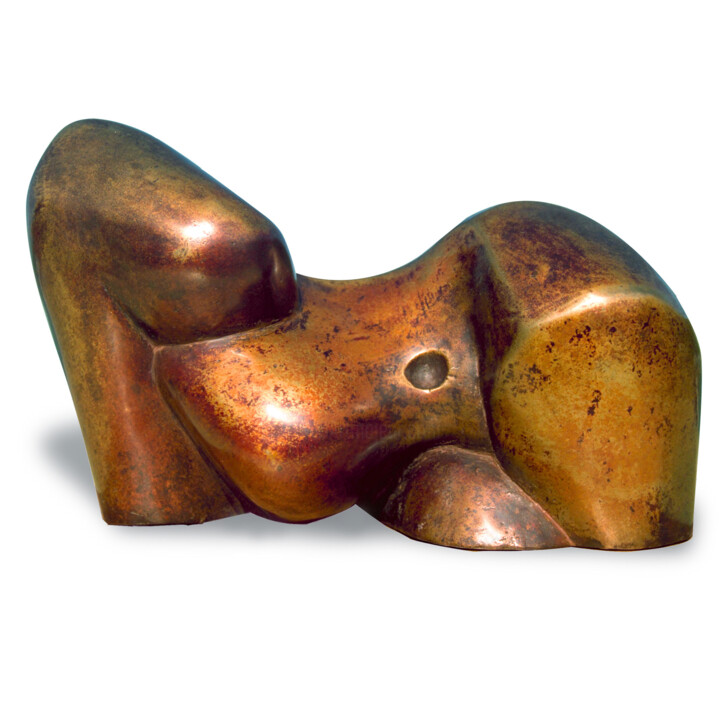
Stephen Williams is a contemporary New Zealand sculptor whose practice explores the relationship between form, balance, tension, and material. His sculptures are shaped by an interest in the aesthetic beauty of forms found in nature, particularly biology and the human body, which he places in dialogue with shapes and structures inspired by manufactured objects.
Through this interaction between organic and industrial influences, Williams creates sculptures that challenge expectations while maintaining a strong sense of visual harmony. His work often explores the tension between contrasting shapes, using unexpected relationships and carefully considered compositions to disrupt symmetry and predictability.
Working with materials including glass and bronze, Williams continues to investigate how sculpture can transform the way viewers understand shape, space, light, and structure.
The Tension Between Contrasting Forms
Tension and balance are central to Stephen Williams’ approach to sculpture. His works often bring together contrasting shapes and forms, creating a visual relationship that encourages viewers to consider how different elements interact.
The tension within his sculptures can emerge from the contrast between organic and manufactured forms. Natural shapes often carry a sense of irregularity and unpredictability, while manufactured objects tend to be associated with precision, symmetry, and repetition.
Williams brings these opposing qualities together, creating sculptures that exist somewhere between the natural and the constructed. The resulting forms can feel familiar yet unexpected, inviting viewers to reconsider their assumptions about balance and structure.
This relationship between opposing elements is an important part of the visual experience. Rather than allowing symmetry or predictability to dominate, Williams introduces disruptions that create movement and visual interest.
Finding Beauty in Biology and the Human Form
The natural world provides an important source of inspiration for Williams. He explores the aesthetic qualities of shapes found in biology and the human body, looking closely at the forms, curves, structures, and proportions that occur naturally.
The human body, in particular, offers endless possibilities for sculptural interpretation. Its combination of organic curves and structural complexity provides a foundation for exploring ideas of balance, movement, and proportion.
Williams does not simply reproduce these forms. Instead, he examines their visual qualities and transforms them through his own artistic process. By abstracting or altering familiar structures, he creates sculptures that maintain a connection to the natural world while developing an identity of their own.
His interest in biology also reflects a broader fascination with the ways nature creates complex forms. Organic structures can appear both highly ordered and unpredictable, offering an interesting contrast to the precise geometry often associated with manufactured objects.
The Influence of Manufactured Design
Alongside organic forms, Williams draws inspiration from designs found in manufactured products. These industrial influences introduce another layer of visual language into his sculptures.
Manufactured objects are often designed according to principles of efficiency, symmetry, and functionality. Their shapes may be carefully engineered to perform a specific purpose, resulting in forms that can appear highly controlled.
Williams takes elements of this visual language and places them alongside the irregularity and complexity of organic forms. This juxtaposition creates a dialogue between nature and human-made design.
The contrast allows him to question ideas of perfection and predictability. By disrupting the symmetry of these forms, he creates sculptures that feel more dynamic and visually complex.
At the same time, Williams remains careful to preserve the integrity of each sculpture. The disruptions are not arbitrary; they are part of a thoughtful process in which every element contributes to the overall balance of the work.
Disrupting Symmetry and Predictability
Symmetry often creates a sense of order and stability, but Williams is interested in what happens when that sense of order is interrupted.
His sculptures challenge predictable arrangements by introducing unexpected shifts in shape, proportion, and structure. These disruptions create tension while also encouraging the viewer to explore the work from different perspectives.
The sculpture may appear balanced from one angle but reveal a different relationship between its forms when viewed from another. This encourages an active engagement with the artwork, as viewers are invited to move around it and discover how its shapes interact in space.
Despite this disruption, Williams’ sculptures retain a sense of cohesion. The individual elements remain connected, allowing the work to maintain its overall integrity.
This balance between disruption and unity is one of the most compelling aspects of his practice. His sculptures demonstrate that harmony does not necessarily require perfect symmetry.
The Fascination of Hollow Glass
In addition to creating solid glass sculptures, Williams finds particular pleasure in crafting hollow pieces. Working with hollow glass introduces an additional dimension to his artistic practice, allowing the interior of the sculpture to become an important part of the artwork.
Rather than treating the sculpture as a solid object with a defined exterior, hollow glass allows Williams to explore the relationship between inside and outside. The empty space within the sculpture becomes visually significant, contributing to the overall composition.
This approach creates a sense of depth and complexity. The viewer is encouraged to consider not only the outer surface but also the space contained within it.
The interior can become an active participant in the sculpture, creating visual relationships between the material, the surrounding environment, and the light passing through or around the piece.
Glass, Light, and Transparency
Although Williams continues to appreciate working with bronze, glass holds a particular fascination for him because of its unique visual properties.
One of the most captivating qualities of glass is its extensive range of colors. This allows Williams to explore a broad spectrum of visual possibilities, from subtle tonal variations to more vibrant and dramatic effects.
Light also plays a central role in his relationship with glass. Unlike opaque materials, glass can interact directly with its surroundings. Light can pass through the material, reflect from its surfaces, or become transformed by its color and texture.
This interplay between light and glass gives Williams’ sculptures an ever-changing quality. The appearance of a piece can shift depending on its surroundings, the position of the viewer, and the available light.
Transparency adds another dimension to this experience. It allows viewers to see into and through parts of the sculpture, creating visual relationships that would not be possible with more traditional solid materials.
For Williams, this quality makes glass particularly captivating. The material is not simply a medium for creating a physical object; it becomes an active part of the visual experience.
The Dialogue Between Material and Form
Williams’ choice of materials is closely connected to the ideas he explores. Glass and bronze each offer very different possibilities, allowing him to approach sculpture from multiple perspectives.
Bronze provides solidity, weight, and permanence. Its physical presence can emphasize the structural qualities of a sculpture, making the relationship between form and mass particularly apparent.
Glass, by contrast, introduces lightness, transparency, and color. It can appear solid and fragile at the same time, creating a fascinating contrast between physical presence and visual delicacy.
By working with both materials, Williams can explore how the same conceptual interests balance, tension, form, and structure can be expressed through entirely different physical qualities.
An Ongoing Exploration of Sculpture
Stephen Williams’ artistic practice reflects a deep interest in the possibilities of three-dimensional form. By bringing together influences from biology, the human body, and manufactured design, he creates sculptures that explore the boundaries between natural and constructed forms.
His work challenges symmetry without sacrificing balance, creating visual tension while maintaining the integrity of each piece. His exploration of hollow glass further expands these ideas by making interior space an essential part of the sculpture.
Through his fascination with glass, Williams also introduces color, transparency, and light into his creative vocabulary. These qualities allow his sculptures to interact with their surroundings in constantly changing ways.
Ultimately, Stephen Williams’ sculptures invite viewers to reconsider how they understand balance and beauty. His work demonstrates that harmony can emerge from contrast and that disruption can exist alongside structure. Whether working with the solidity of bronze or the luminous qualities of glass, he continues to explore how materials, forms, and spaces can come together to create sculptures that are both visually compelling and conceptually thoughtful.