



James Day has spent a quarter century developing a visual language that resists easy categorisation, and the shape of that development says as much about his art as any single painting does. To trace his output from 2001 to the present is to watch an artist move steadily from expression through colour toward a more controlled, more deliberate surrealism, one built on precision rather than spontaneity.
A Vocabulary Built Over Time
Day’s earliest paintings were bright and immediate, favouring colour over detail. The photorealistic technique he later developed marks a considerable departure from that starting point, not because it is more skilled, but because it changes what the work is asking of its audience. Where the early paintings communicate through energy, the later work communicates through accuracy, using a convincingly rendered surface to make its stranger content more believable. This is a common strategy in surrealist painting: the more precisely the ordinary is rendered, the more unsettling the extraordinary becomes when it is introduced.
Ordinary Objects, Unusual Company
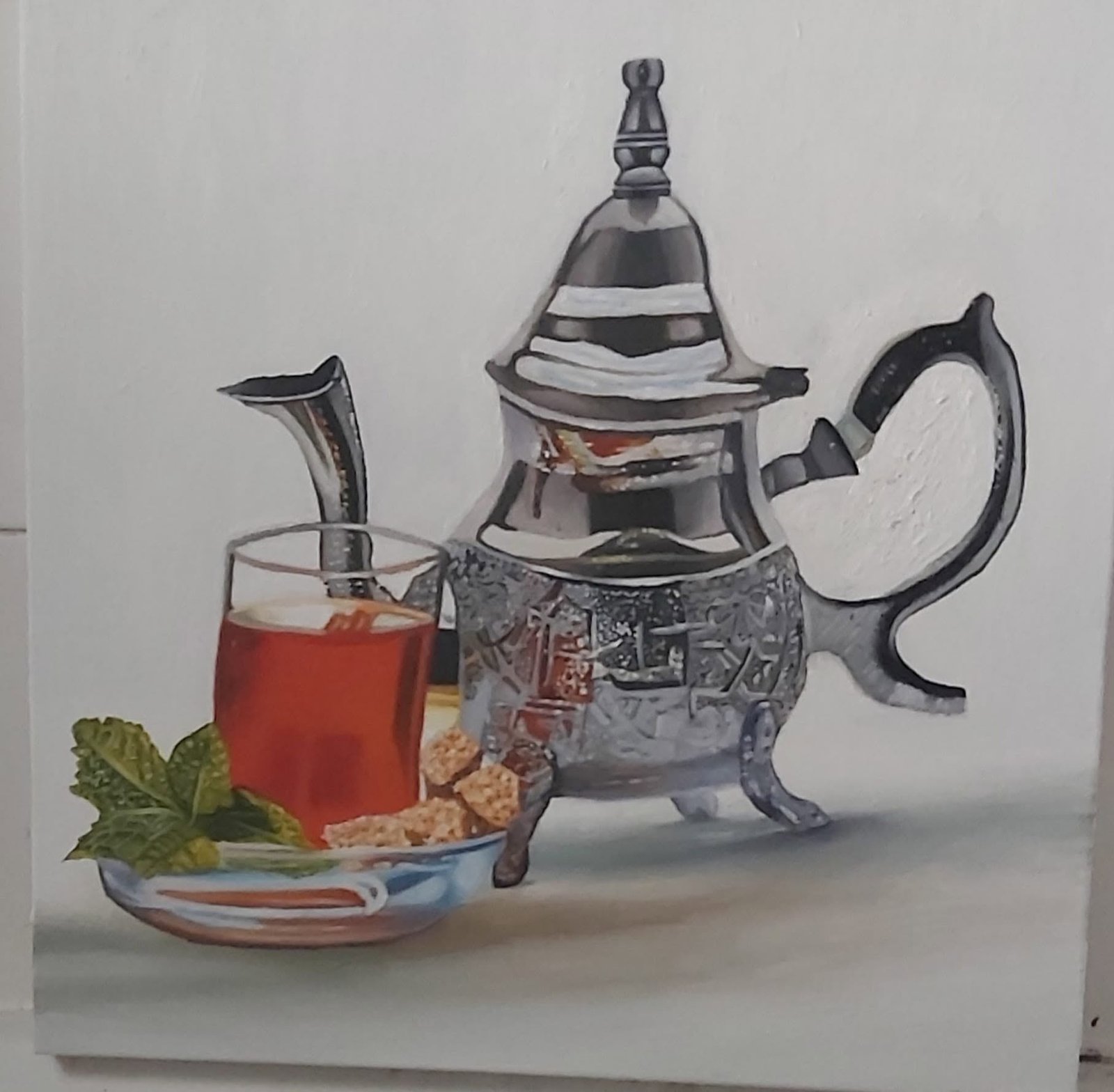
That strategy is visible across Day’s mature work, where familiar objects are frequently placed into unfamiliar company. I Like Mint Tea is the most restrained example. On its surface, it is a straightforward still life, a glass of tea beside an Islamic teapot, painted with enough clarity that the viewer can almost register the temperature of the glass. But the painting also carries the weight of two decades of interest in Islamic visual culture, first expressed in bright architectural drawings in the 2000s and later in cartoon work through the 2010s. Read in that context, the still life becomes less a simple subject and more a considered return, executed now with a technical control that the earlier work did not yet have.
Eye, Fruit Cocktail, and the Logic of Beauty
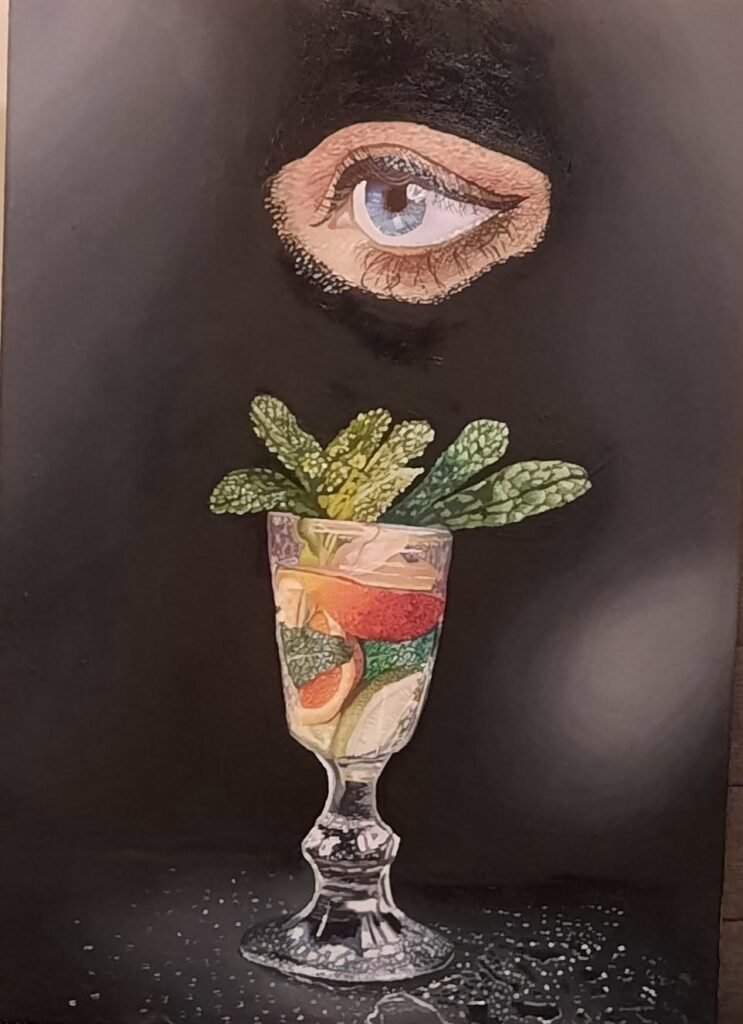
Beauty Is in the Eye of the Beholder operates on a different register entirely. Here Day pairs an eye with a glass of fruit cocktail, two objects with no obvious relationship beyond the title’s implication that both might be considered beautiful. The painting’s debt to Salvador Dalí is explicit, and Day has pointed specifically to Dalí’s contribution to the dream sequence in Alfred Hitchcock’s Spellbound as a reference point, particularly its treatment of the eye as a recurring surrealist motif. It would be a mistake to read the painting as a literal restaging of that film sequence; rather, it borrows its visual logic, the idea that meaning can be constructed through juxtaposition rather than narrative. What the painting suggests, without insisting on it, is that beauty is not a fixed quality but something contingent on how and where it is found.
Landscape as Symbol in Gravity
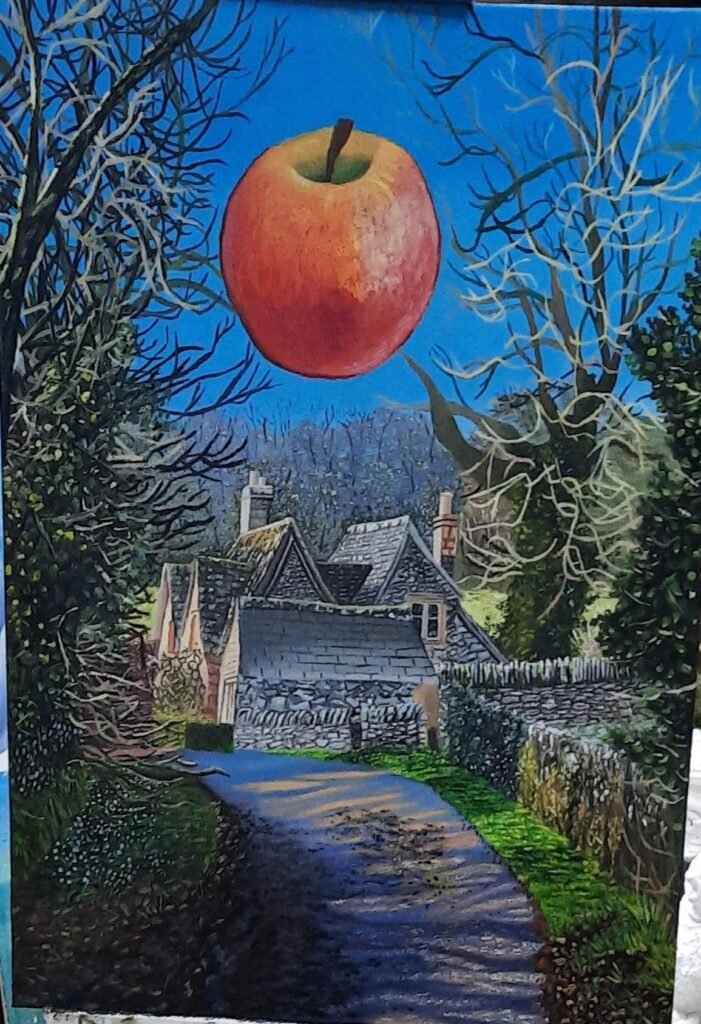
Gravity, from 2025, extends this juxtaposition into landscape. An apple rises into the sky above a stretch of English countryside associated with the kind of terrain Isaac Newton would have known. The image works on two levels simultaneously: as pure surrealist inversion, gravity reversed, and as a deliberate historical gesture, anchoring the fantastical in a specific cultural memory. Day has connected the painting to his own experience as an autistic artist, describing an affinity with historical figures such as Newton, whom he regards as evidence that unconventional thinking can produce lasting value. This is presented as a personal framework rather than a verified biographical claim about Newton himself, and the painting is stronger for holding that ambiguity rather than resolving it.
Into Three Dimensions
Since 2020, Day’s surrealist instincts have extended into sculpture and diorama making, a shift that follows logically from paintings already concerned with constructed scenes and unlikely combinations. Where the paintings ask viewers to imagine a space beyond the frame, the dioramas build that space directly, giving Day’s juxtapositions a physical presence they could not have on canvas.
A Practice Still in Motion
His current dioramas, populated with zombies on holiday, continue this trajectory of the familiar rendered strange, tourism recast through an absurd lens. It is a fitting extension of an artistic project that has, across twenty-five years, consistently found meaning in the friction between the ordinary and the unexpected. Day’s work does not offer conclusions so much as arrangements, leaving viewers to draw their own connections between tea and refreshment, eyes and fruit, apples and gravity, holiday and horror.
Explore the Collection: Discover James Day’s latest dioramas, surrealist paintings, and works-in-progress on Instagram at @thequirkypainter5.