



Natalie Angel begins each painting without a plan. This is not carelessness; it is method. She lets emotion arrive first, unnamed, unsorted, and only afterward does the imagery form around it. The result is a body of work that reads less like a set of finished statements and more like a series of unfinished conversations between an inner life and the world that shaped it.
This intuitive approach places Angel’s practice within a broader avant-garde sensibility, one less concerned with technical formula than with honesty. She paints identity, transformation, freedom and resilience not as abstract concepts but as felt experiences, the kind that resist language and demand a different outlet. Her canvases become that outlet: a place where memory, dream and unspoken feeling can finally take shape.
The Shapes Threats Wear
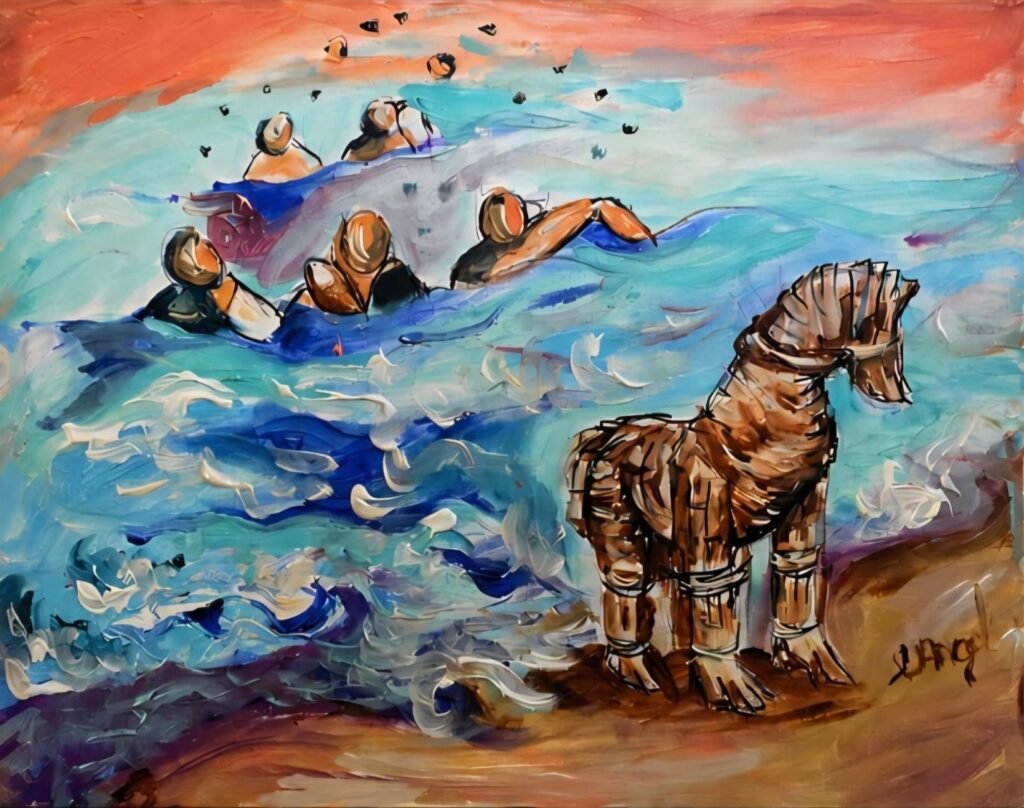
In “Trojan Horse,” an acrylic work completed in 2026, Angel turns her attention outward, toward the architecture of deception itself. The artist’s own words frame the piece plainly: the Trojan Horse never disappeared, she suggests it simply changed its shape. It is a quiet but unsettling proposition, one that resists any single historical or political reading and instead asks a more enduring question: how do we recognize danger once it has learned to look like safety?
There is no accusation embedded in the painting, no finger pointed at a specific target. What Angel offers instead is a meditation on vigilance the discipline of looking twice at what appears familiar, of understanding that protection is not a one-time act but an ongoing practice. It is a theme that connects naturally to her larger concerns with resilience: the strength required not just to survive deception, but to remain alert to its evolving disguises.
Fire That Does Not Consume
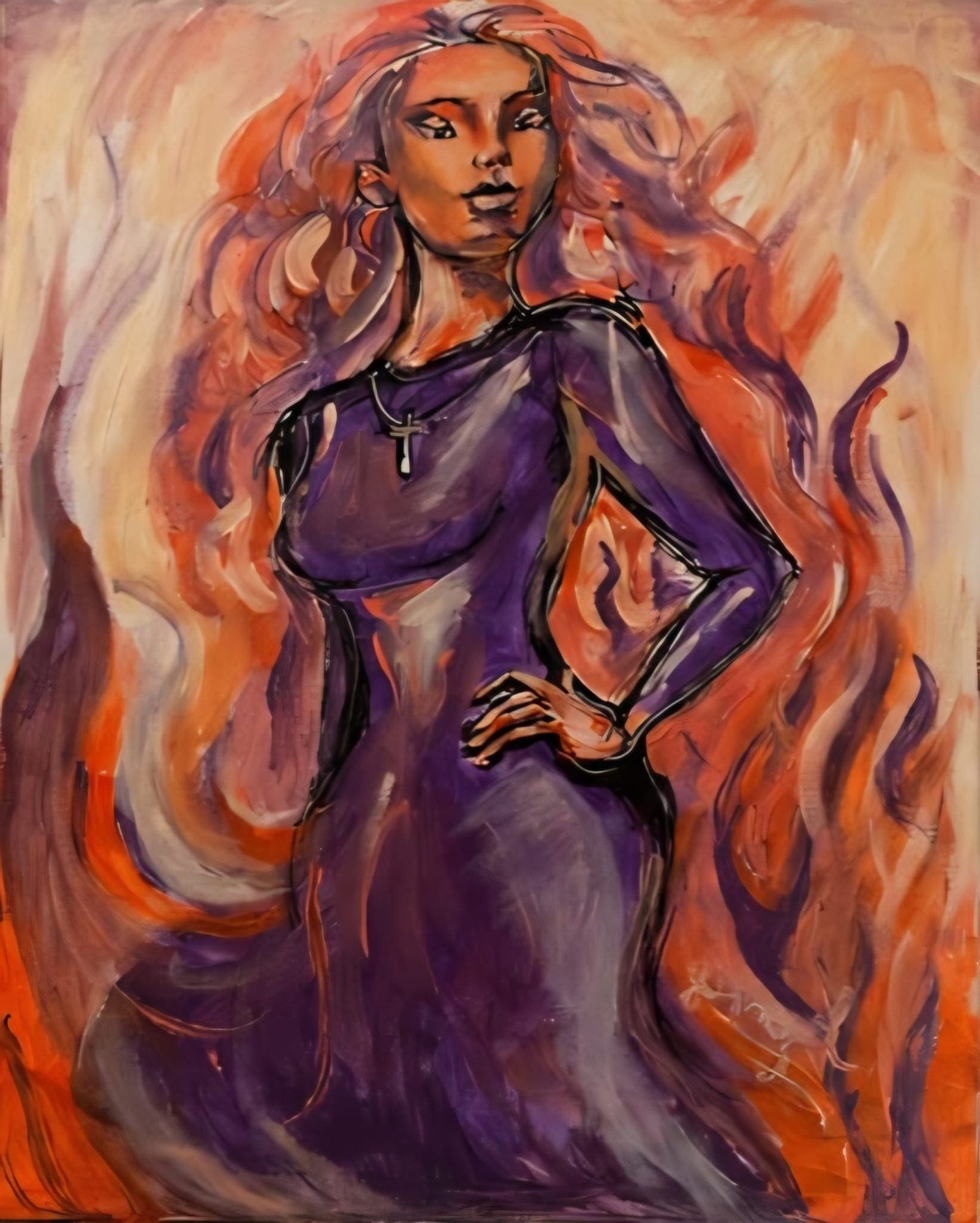
If “Trojan Horse” looks outward, “Faith and Fire” turns inward. Painted in acrylic in 2026, the work carries a statement that refuses the obvious metaphor. Not every flame destroys, Angel writes; some reveal the woman a person was always meant to become. This is fire reimagined not as ruin, but as revelation.
It would be easy to flatten this idea into a simple symbol of passion. Angel resists that flattening. Her fire is closer to a threshold than a destination: something one walks through rather than something one simply feels. Transformation, in her hands, is neither comfortable nor purely destructive. It is a process that asks something of the self and, in exchange, uncovers a version of that self previously hidden. The painting sits comfortably alongside Angel’s stated interest in identity as something built through experience rather than fixed from the start a becoming, not a given.
Curiosity Instead of Certainty
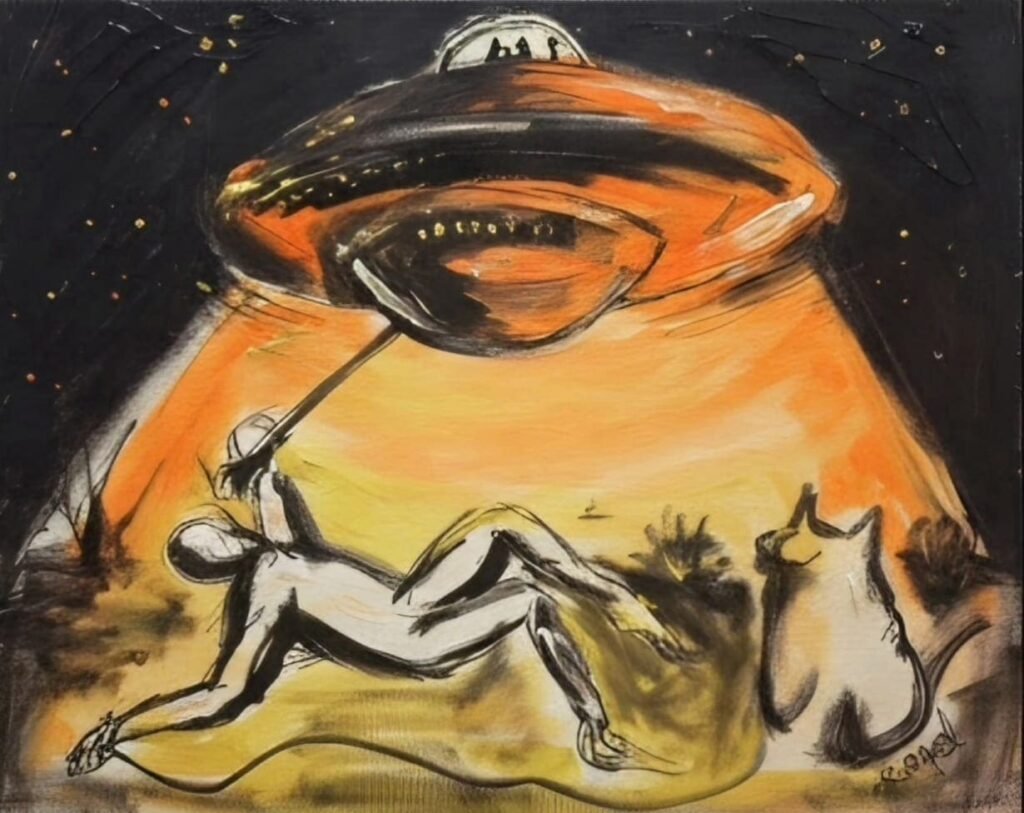
The third major work, “Between Earth and Elsewhere,” approaches transformation from an entirely different angle not through fire or history, but through the unexplained. A mysterious presence descends from above. A small dog watches, unbothered. A human figure stays grounded, neither fleeing nor reaching. Nothing in the scene insists on fear.
Angel has described the painting as an invitation to ask a simple but profound question: what if the unknown arrives not to take something from us, but to awaken our curiosity? It is a striking reversal of instinct. Most depictions of the unfamiliar lean toward threat; Angel’s leans toward wonder. The painting sits at the exact point where imagination and reality blur, where fascination and fear occupy the same breath, and it suggests that the most meaningful discoveries begin precisely when a viewer chooses openness over suspicion.
Taken together with “Trojan Horse” and “Faith and Fire,” this painting completes a kind of emotional triptych vigilance, transformation, and wonder three different postures the self might take when facing what it cannot fully control.
Painting the Unspoken
What unites these three works is not subject matter but sensibility. Angel is drawn to what cannot easily be spoken: the residue of memory, the pull of an unnamed feeling, the invisible threads that connect one person’s experience to another’s. Her paintings do not attempt to explain these things. They attempt to hold them, the way a held breath holds tension without resolving it.
This is, in part, why her work resists easy categorization. It is emotional without being sentimental, symbolic without becoming didactic. Each canvas seems to ask the viewer to bring something of their own to it a memory, a fear, a private hope and to find, somewhere in the paint, a fragment of their own story looking back.
Building Outward
Angel’s ambitions extend beyond the studio. Working under the name Natalie Angel, she is in the early stages of building an international practice, with a clear hope of reaching galleries, collectors and art lovers beyond her immediate circle. There is no claim here of institutional backing or established representation, only intention, and the steady accumulation of work that might eventually meet the audiences she is seeking.
That patience feels consistent with the paintings themselves, which never rush toward resolution. They linger. They ask questions rather than answer them.
A Closing Note on Becoming
What lingers after encountering Angel’s work is not a single image but a feeling, the sense that transformation, however it arrives- through fire, through vigilance, through an unexplained presence in the sky- is always available. Her paintings do not promise ease. They promise possibility: that feeling can be processed, that identity can shift, that the unfamiliar might be curiosity in disguise rather than something to fear. In that quiet insistence lies the heart of her practice.
Discover More
Website: http://www.natalie-angel-art.nl
Instagram: @natalieangelart