



Roughly eight years ago, Lib Mason found herself facing a question most artists never get to ask cleanly: what would she paint if there were no client, no assignment, and no brand waiting for the final product? For decades, her working life as a commercial illustrator creating imagery for major publications including Rolling Stone and Time Life Warner, and later developing product lines and artist-branded licensed collections had been defined by other people’s needs. When that career ended, the silence that followed wasn’t empty. It was an opening.
The Question Behind the Return
Mason had studied editorial illustration at the Rhode Island School of Design, training that shaped her instincts around communication, clarity, and impact. Those instincts didn’t disappear when she stopped working commercially; they simply found a new outlet. Instead of building images to satisfy an art director’s request, she began building images to satisfy her own curiosity about the world around her its politics, its social fractures, its environmental unraveling.
The medium she chose to explore that curiosity was oil painting, and the technique she chose was demanding by design: the Flemish method, built on a monochrome grisaille underpainting that establishes form and light, followed by layer upon layer of transparent glaze that lets color and luminosity emerge slowly. It is, in a sense, the opposite of illustration’s need for speed. Where commercial work rewards immediacy, this technique rewards patience, and Mason seems to have wanted exactly that shift.
Freedom to Be Indirect
Freed from a brief, Mason didn’t turn toward comfortable subject matter. She turned toward difficulty: contemporary political, social, and environmental events, the kind of material that would be easy to illustrate literally and easy to render as protest art. She chose neither path. Instead, her artist statement describes an interest in beauty, symbolism, humor, and absurdity as tools for approaching subjects that are unsettling, a way of inviting a viewer in before revealing what a painting is actually about.
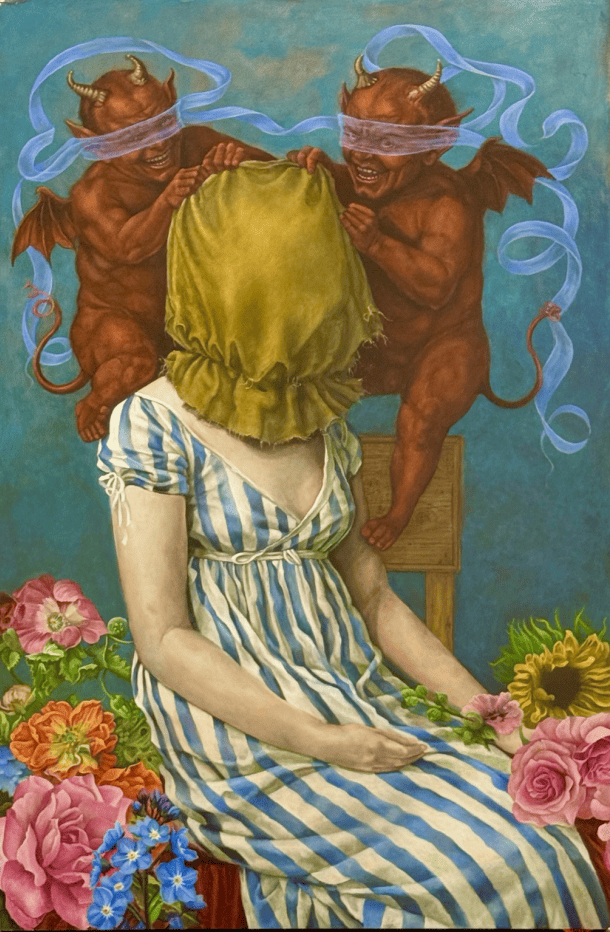
That approach becomes clear in RIP ICE, painted in response to the shooting of Renee Good. Two grinning, blindfolded devils pull a hood over a seated woman, the entire scene wrapped in brilliant color and flowers. The woman’s skin is painted chalky and uneven, intentionally unmoored from any specific racial identity, so she might represent anyone. The devils’ blindfolds point to something more troubling than cruelty alone a force acting without truly seeing the person in front of it. Mason has spoken of this painting as a reflection of what happens when power goes inadequately trained and unchecked: no one, she suggests, is necessarily beyond its reach.
Building a Different Kind of Wall
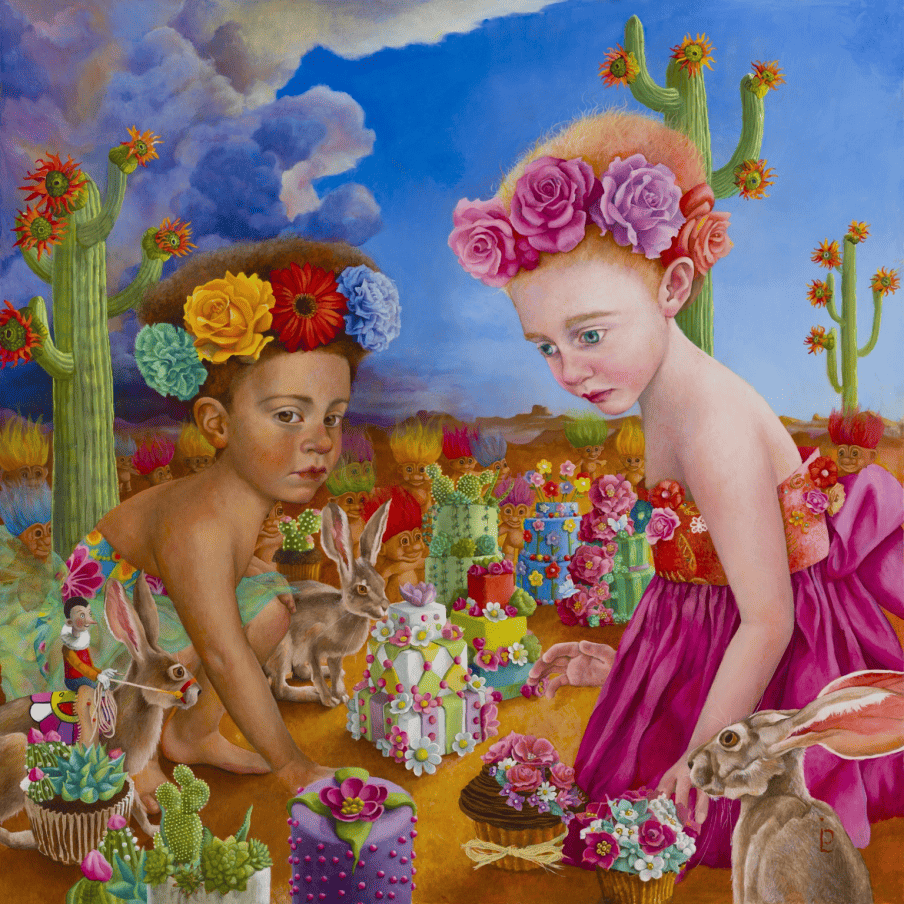
A similar instinct drives Esparza, Nadine and the Beautiful Wall, a response to the wall built along the border between Mexico and the United States. Mason found the structure both troubling and absurd, particularly in how it disrupts the natural migration patterns of animals along with people. Her response wasn’t to paint the wall as it exists. It was to imagine something else entirely: two young girls building their own wall out of cakes, meant to keep out trolls rather than people. Pinocchio stands nearby, a small witness to a world where truth and lies have become difficult to tell apart.
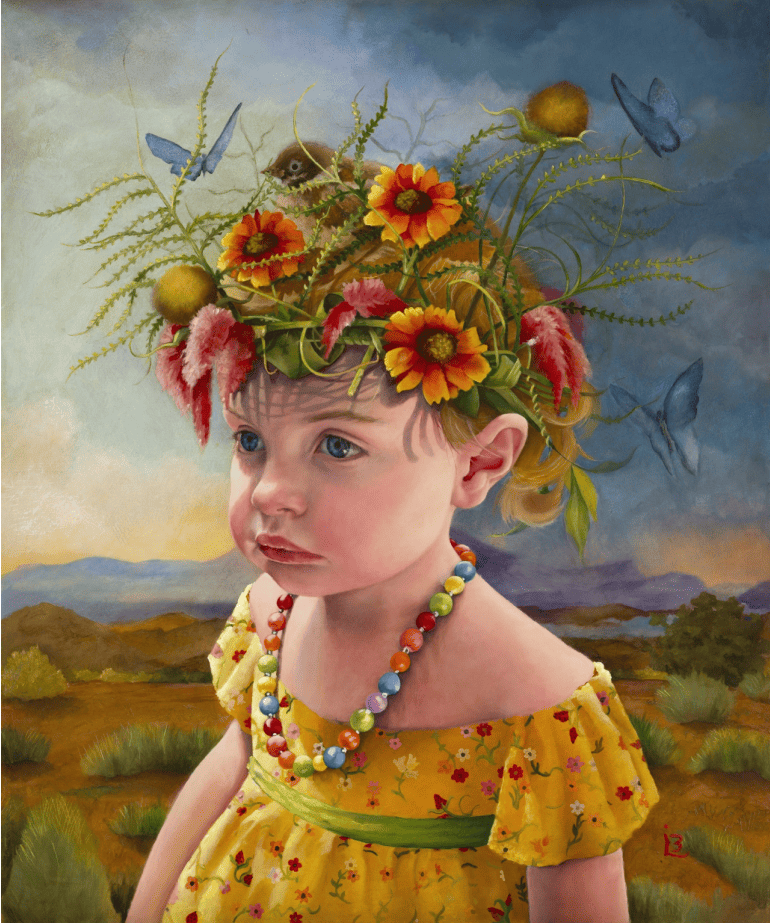
And in Flight, the artist’s environmental concerns take shape through a single figure: a young girl alone in a barren landscape. The painting doesn’t editorialize. It simply places a child at the edge of a damaged world and asks, quietly, what kind of planet she’s been handed.
A Practice Built on Her Own Terms
What connects these three paintings is not just subject matter, but the freedom behind them. None of these images could have existed inside Mason’s earlier commercial career, not because the technical skill wasn’t there, but because the purpose wasn’t hers to define. Now it is. The eight years since she stepped away from illustration have given her room to develop a body of work that treats contemporary anxiety as material worth slowing down for, worth layering in glaze after glaze until the color and the meaning both arrive at their own pace.
There’s something notable in the fact that a career built on speed and client approval eventually led to a practice built on patience and personal conviction. Mason’s paintings don’t rush to make their point. They let a viewer arrive at difficulty gradually, the way light gathers in a glazed panel slowly, and only after the surface has done its work of pulling you in.
That, in the end, may be the most honest answer to the question she faced eight years ago. What she paints now, with no one asking her to, is exactly what she couldn’t have painted before.
See more of Lib Mason’s original works at libmasonartist.com
and follow her daily studio progress on Instagram @libmason5687.