



Karla Ochoa Pesantez remembers her mother’s workshop the way some people remember a favorite room in a childhood home, not as a single image but as a collection of sensations: the smell of fabric, the sound of a needle pulling thread, the particular patience required to finish something by hand. She grew up in Cuenca, Ecuador, and spent much of her early years in the nearby town of Paute, where her mother, Sara Isabel Pesantez, worked as a local artisan and artist, painting, sewing, knitting, and decorating. Whatever free time Karla had as a girl, she spent nearby, watching. She did not know it then, but she was being trained in something.
The Gymnast Before the Painter
Long before she considered herself an artist, Karla was something else entirely: a competitive gymnast. From the age of seven until she was fourteen, she trained at a level serious enough to win multiple national championships in Ecuador. Gymnastics is an unforgiving discipline. It asks a child’s body to learn balance, timing, and control with a precision that has no room for approximation. Karla spent those years building exactly that kind of precision into her hands and her instincts, though she had no reason at the time to think it would matter for anything beyond the sport itself.
An Unexpected Beginning
Painting entered her life much later, and almost by accident. It was her son, Inti, who first encouraged her to try it, treating it as something casual, a hobby to fill quiet hours. What emerged instead was a talent that seemed to arrive fully formed, as though it had been waiting. Karla does not describe this discovery in terms of ambition or career planning. She describes it as a gift, something given rather than earned, and she has approached her practice ever since with a sense of humility that shapes both how she works and what she chooses to paint. Prayer and meditation are part of her daily rhythm, and so is an abiding interest in kindness, nature, and the idea that people, whatever their differences, are fundamentally connected.
Hands That Remember
What is striking about watching Karla work, or hearing her describe how she works, is how much of her gymnastics training seems to have quietly resurfaced. She paints with both hands, right and left, switching or working simultaneously, and she builds her geometric patterns entirely freehand. No rulers. No stencils. No guides of any kind. The circles close where they are meant to close and the lines meet where they are meant to meet because her hands have learned, over years of a very different kind of discipline, how to be exact. It is tempting to see this as a coincidence, a gymnast who happens to also be a painter, but spend enough time with her work and it starts to look more like a continuation, the same body finding a new way to perform the same kind of care.
A Message Beneath the Geometry
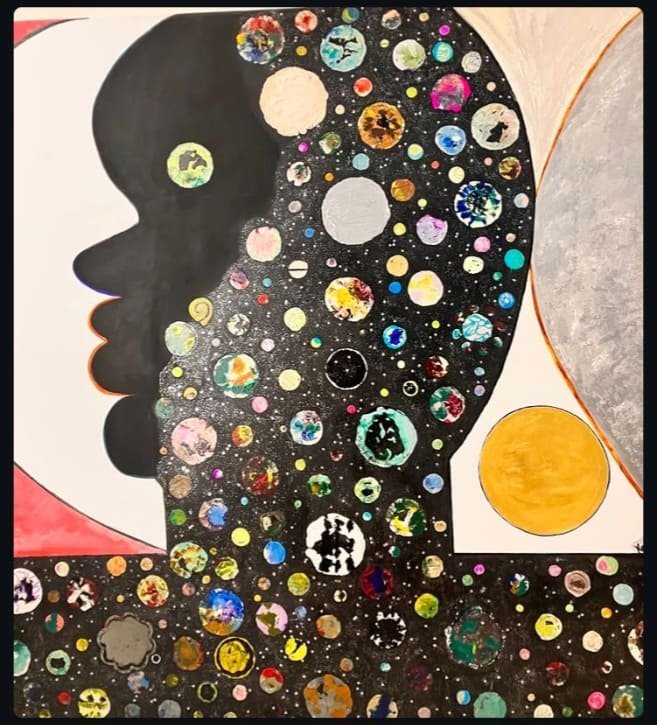
Her piece “Universal Geometry & Equality” makes this most visible. Karla has spoken about wanting to build the work with real discipline and concentration, and about wanting it to carry something more than visual interest. The geometric forms, straight lines, circles, squares, verticals, were all constructed by hand, without patterns, using both her right and left hands so that everything would align despite having no external structure to rely on. At the center of the composition sits a dark-skinned human figure, set against the imagery of the universe and a dark background alive with color. She has been direct about what that figure means to her: a refusal of racism, an insistence that all people are equal regardless of color, and a reminder that everyone lives beneath the same sky. The exactness of the geometry becomes, in this context, a kind of quiet argument for order and fairness rendered in visual form.
The River, the Sea, and Her Mother’s Name
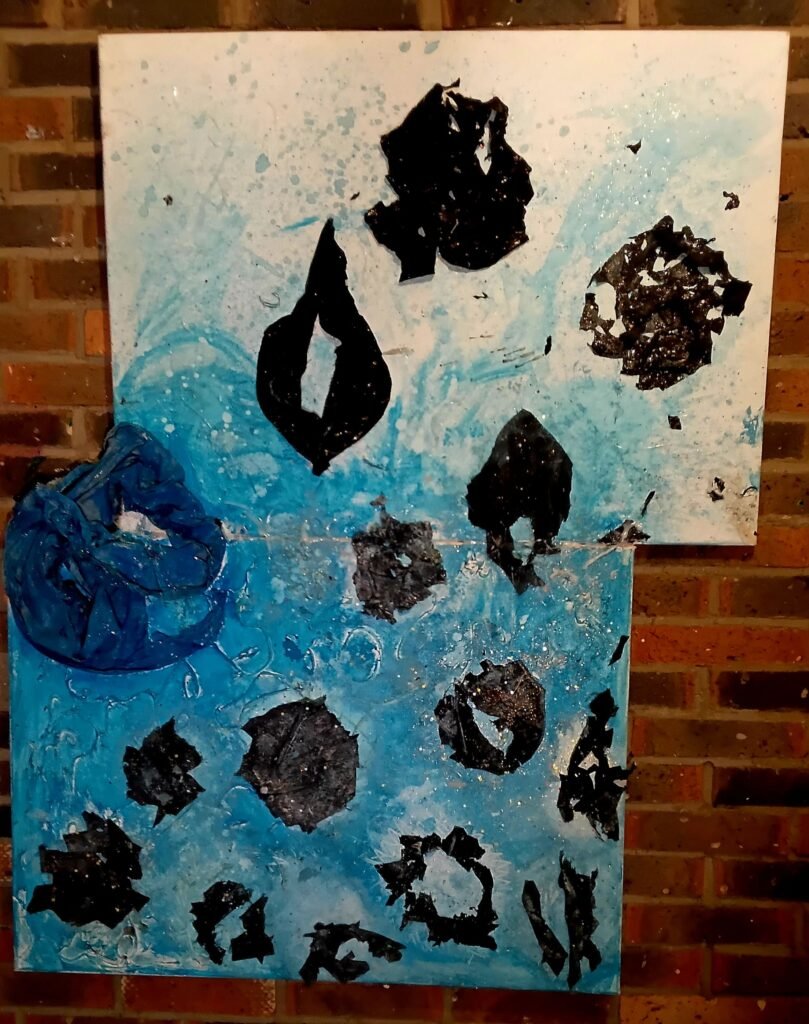
“Sahara Sea,” finished in July 2026 and measuring 1.80 by 1.50 meters, carries a gentler, more personal weight. Karla has described being drawn to the sea as it looks from high above, its waves and islands arranged like a map, but the deeper source of the piece sits closer to home, in memories of Sunday afternoons spent as a family by the river near where she grew up. Built from fabric, acrylic, and silicone, the work is abstract and was made to hang in a way that allows it to rotate, so that each side reveals its own version of the same underlying pattern. Karla named the piece for her mother, and it is not hard to see why. The materials themselves, textile worked alongside paint, carry an echo of the workshop where she first learned that things could be built by hand with patience and attention. Turning the piece changes what you see, much the way memory itself keeps shifting shape depending on which angle you approach it from.
Borrowing From Gaudí, Arriving Somewhere Else
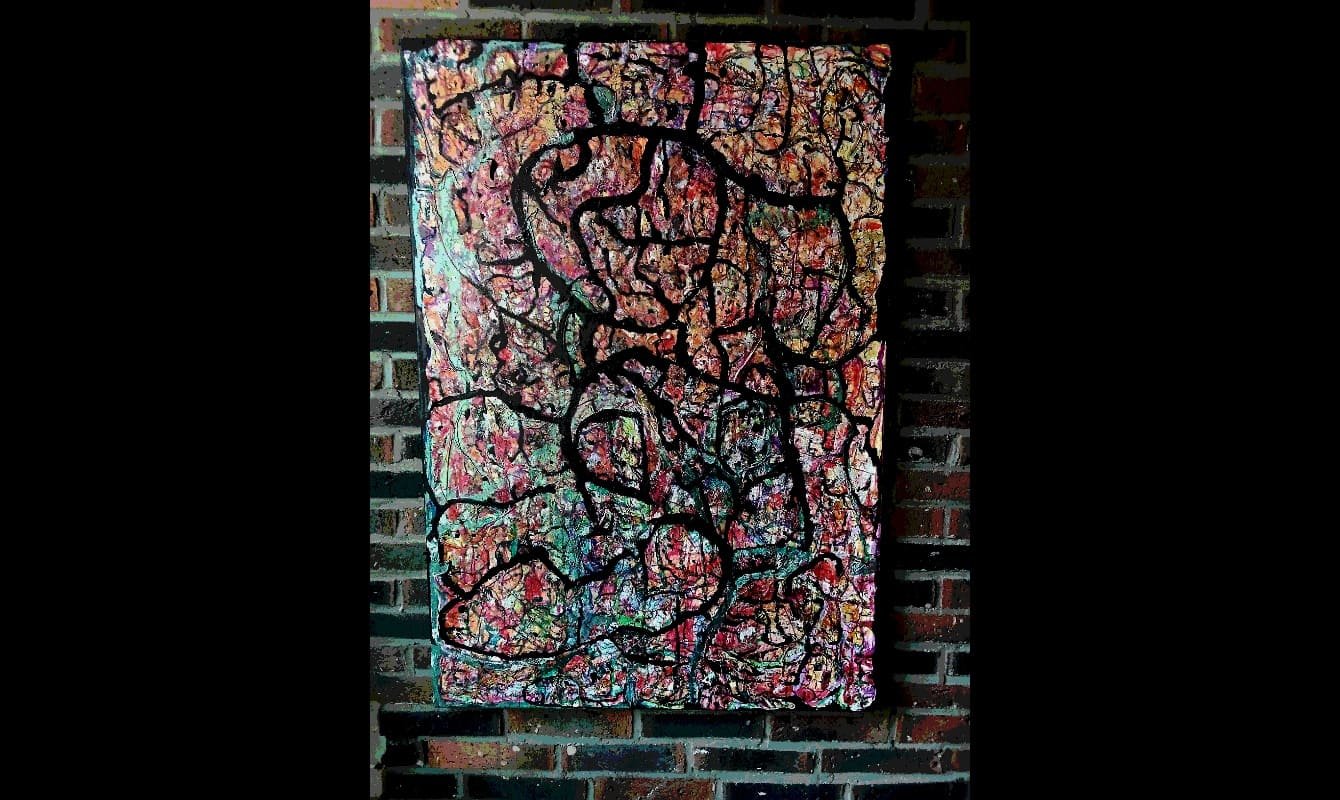
The third piece in this group takes Gaudí as a starting point, though what results feels entirely like Karla’s own. Rendered in vivid, shimmering color and built in a semi-abstract style with touches of realism, the work is dense with hidden content. Look closely and faces appear, along with animals, masks, and small character-like forms scattered at different scales throughout the composition, some so small they might be missed on a first look, others large enough to anchor the entire piece. It was designed to be hung and viewed both horizontally and vertically, meaning the same canvas offers two different visual experiences depending on how it is positioned. Gaudí’s influence is present, but it functions less like an homage and more like a doorway into Karla’s own imagination.
What Comes Next
Taken together, these three works trace a fairly clear line back to where Karla started: a childhood spent watching her mother work with her hands, years spent training her body toward precision, and a spiritual life that treats the ability to make something meaningful as a form of grace rather than achievement. Her paintings ask to be looked at more than once, turned, tilted, reconsidered, because that is how she seems to understand the world itself. Nothing stays fixed from a single angle. What she is building now, piece by piece, is a practice that keeps proving there was always more to find in it than the first glance suggested.
Explore Karla’s latest freehand works, studio updates, and process videos on Instagram:@art_by_cocoo.