



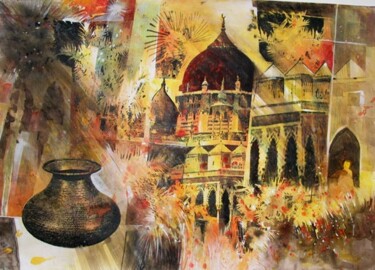
Anuar Dan is a Malaysian artist whose paintings explore the vibrant relationship between urban environments, natural landscapes, cultural heritage, and the passage of time. Through expressive brushwork, bold colors, and abstracted geometric forms, he creates compositions that capture both the energy of modern life and the enduring beauty of traditional surroundings.
Working primarily with acrylic on canvas, Anuar Dan brings architectural structures and natural elements together in dynamic visual arrangements. His paintings often reflect the changing character of the environments around him, particularly the gradual transformation of traditional ways of life as modern urban development continues to reshape familiar landscapes.
With a background in graphic design and a practice influenced by local architectural motifs and mixed media techniques, Anuar Dan has developed a distinctive artistic language that combines contemporary visual expression with cultural memory.
Exploring Urban and Natural Landscapes
The relationship between the built environment and nature is central to Anuar Dan’s artistic practice. His paintings often bring together architectural forms, city structures, and natural elements, creating compositions that reflect the complex visual character of contemporary environments.
Urban landscapes provide him with opportunities to explore movement, energy, and geometric structure. Buildings and architectural forms can become abstract shapes that interact across the canvas, creating a sense of rhythm and visual movement.
At the same time, natural landscapes introduce another kind of energy. Trees, vegetation, and organic forms provide contrast to the rigid lines and geometric structures associated with architecture.
By placing these elements together, Anuar Dan creates a visual dialogue between the natural and constructed worlds. His paintings suggest that these two environments are not completely separate but constantly influence and reshape one another.
The Energy of Bold Color
Color is one of the most recognizable features of Anuar Dan’s work. His compositions often feature vibrant and expressive colors that give his paintings a strong visual presence.
Rather than using color simply to reproduce the appearance of a particular location, he uses it as an expressive tool. Bright tones can communicate the energy of a busy urban environment, while combinations of rich and contrasting colors can create a sense of movement across the canvas.
His approach to color also contributes to the abstract quality of his work. Familiar landscapes may be transformed through unexpected combinations of tones, encouraging viewers to experience the scene through emotion and atmosphere rather than literal representation.
The result is a visual language that feels energetic and contemporary while remaining connected to the places and cultural environments that inspire him.
Geometric Forms and Abstraction
Anuar Dan’s use of abstracted geometric shapes adds another dimension to his paintings. Architectural elements can be simplified or transformed into bold forms, creating compositions that balance recognizable imagery with abstraction.
These geometric structures help organize the visual space of the canvas. They create rhythm and structure while allowing the artist to move beyond traditional forms of landscape representation.
His approach reflects the influence of his graphic design education, where composition, shape, balance, and visual organization are essential elements.
However, Anuar Dan’s paintings go beyond graphic design principles. His expressive brushwork and textured surfaces introduce a sense of spontaneity and emotion, creating a balance between controlled structure and artistic freedom.
A Foundation in Graphic Design
Anuar Dan’s artistic development was shaped in part by his training in graphic design at the University of Technology Mara (UiTM) in Shah Alam.
This background provided him with an understanding of visual composition, form, color, and communication. These principles can be seen in the organized structures within his paintings and in the way he carefully balances different elements across the canvas.
At the same time, his fine art practice allows him to explore ideas that extend beyond purely visual design. His paintings carry cultural and historical meanings, reflecting his interest in heritage, memory, and the changing character of society.
The combination of graphic design knowledge and painterly experimentation has helped him develop a distinctive style that feels both carefully constructed and emotionally expressive.
Cultural Heritage and Malay Architecture
Local cultural heritage is an important source of inspiration for Anuar Dan. His paintings often incorporate motifs and architectural elements associated with Malay culture, allowing traditional visual forms to become part of a contemporary artistic language.
Traditional kampung houses are particularly significant within this context. These structures represent more than physical buildings; they can also symbolize community, memory, tradition, and a way of life that is gradually changing.
By incorporating architectural references into his paintings, Anuar Dan preserves aspects of this visual heritage while reinterpreting them through color, abstraction, and modern artistic techniques.
His work therefore becomes a bridge between the past and the present. Traditional forms are not presented simply as historical images but are transformed into contemporary compositions that encourage viewers to consider their continuing significance.
The Disappearing Kampung House
One of the most meaningful themes in Anuar Dan’s work is the disappearance of traditional kampung houses in the face of modernization.
As cities expand and urban development changes the landscape, traditional structures and familiar environments can gradually disappear. This transformation affects not only the physical appearance of a place but also the cultural memories associated with it.
Anuar Dan’s paintings respond to this change by bringing these traditional forms into focus. His representations serve as visual reminders of environments that may no longer exist in the same way.
By placing traditional houses alongside modern urban structures, he creates a contrast between different periods of development.
The resulting compositions encourage viewers to think about what is gained and what may be lost as societies change. His work does not necessarily reject modernity but instead invites a deeper appreciation of the cultural elements that exist alongside it.
A Dialogue Between Past and Present
Time is an important underlying theme within Anuar Dan’s artistic practice. His paintings often suggest that landscapes are constantly evolving, with elements of the past existing alongside signs of the present.
Traditional architecture and modern buildings can occupy the same visual space, creating a conversation between different generations.
This approach allows his paintings to function as reflections on memory. The viewer is encouraged to consider how familiar places change and how certain objects, buildings, and landscapes become symbols of earlier ways of life.
Through his artistic interpretation, these elements are preserved in a new form. The painting becomes a record of cultural memory while also remaining a contemporary work of art.
Mixed Media and Textural Expression
Anuar Dan’s practice also incorporates mixed media techniques, expanding the possibilities of his visual language.
Texture plays an important role in the way his paintings communicate. Expressive surfaces can add depth to architectural forms and natural elements, making the compositions feel tactile and dynamic.
The combination of different materials and techniques allows him to create visual contrasts between smooth and rough surfaces, structured forms and spontaneous marks.
This experimentation strengthens the relationship between color and texture in his work. Together, they create paintings that invite viewers to look closely at the surface while also considering the broader ideas contained within the composition.
An Evolving Artistic Vision
Throughout his career, Anuar Dan has exhibited widely in Malaysia, participating in numerous solo and group exhibitions. These exhibitions have provided opportunities for audiences to experience the development of his artistic vision and his continued exploration of landscape, architecture, and cultural memory.
His practice remains dynamic, allowing him to experiment with new approaches while maintaining a clear connection to his central themes.
Whether depicting urban environments, natural landscapes, or traditional architectural forms, he continues to explore how visual art can capture the character of a changing world.
His evolving style demonstrates an artist who is interested not only in what a place looks like but also in what it represents.
Preserving the Charm of Local Landscapes
Anuar Dan’s paintings ultimately serve as reminders of the beauty and cultural significance of familiar environments. Through expressive color, geometric abstraction, and innovative approaches to texture, he transforms local landscapes and architectural forms into visually compelling works.
His art encourages viewers to pause and consider the places around them—the buildings, landscapes, and objects that may seem ordinary but carry deep cultural and historical meaning.
By bringing traditional motifs into contemporary compositions, Anuar Dan demonstrates how art can help preserve a connection to the past while remaining firmly engaged with the present.
His work exists at the intersection of tradition and modernity, nature and architecture, memory and change. Through his paintings, disappearing landscapes can be remembered, cultural forms can be reimagined, and familiar environments can be seen from a new perspective.
Ultimately, Anuar Dan’s artistic practice is a celebration of both transformation and continuity. His vibrant paintings capture the energy of contemporary life while honoring the enduring charm of traditional architecture and local landscapes. Through his distinctive combination of bold color, expressive brushwork, geometric forms, and cultural references, he creates a body of work that reflects the evolving relationship between people, places, and time.