



Indra Persad Milowe paints from memory, and her memory begins in Trinidad and Tobago. Born into the sensory abundance of the islands during the 1950s and 1960s, she absorbed the sounds, colors, and rituals that would later resurface, decades later and thousands of miles away, on canvases created in her adopted home of Salem, Massachusetts. The distance between these two places, geographic and cultural, is precisely where her work lives.
Salem is a city built on its own layered history, and it has proven a fitting base for an artist whose practice is fundamentally about preserving what might otherwise fade. Indra’s paintings do not simply illustrate scenes from her childhood; they carry forward traditions, foods, festivals, and instruments that define Trinidadian identity, translating them for audiences who may never have set foot in the Caribbean.
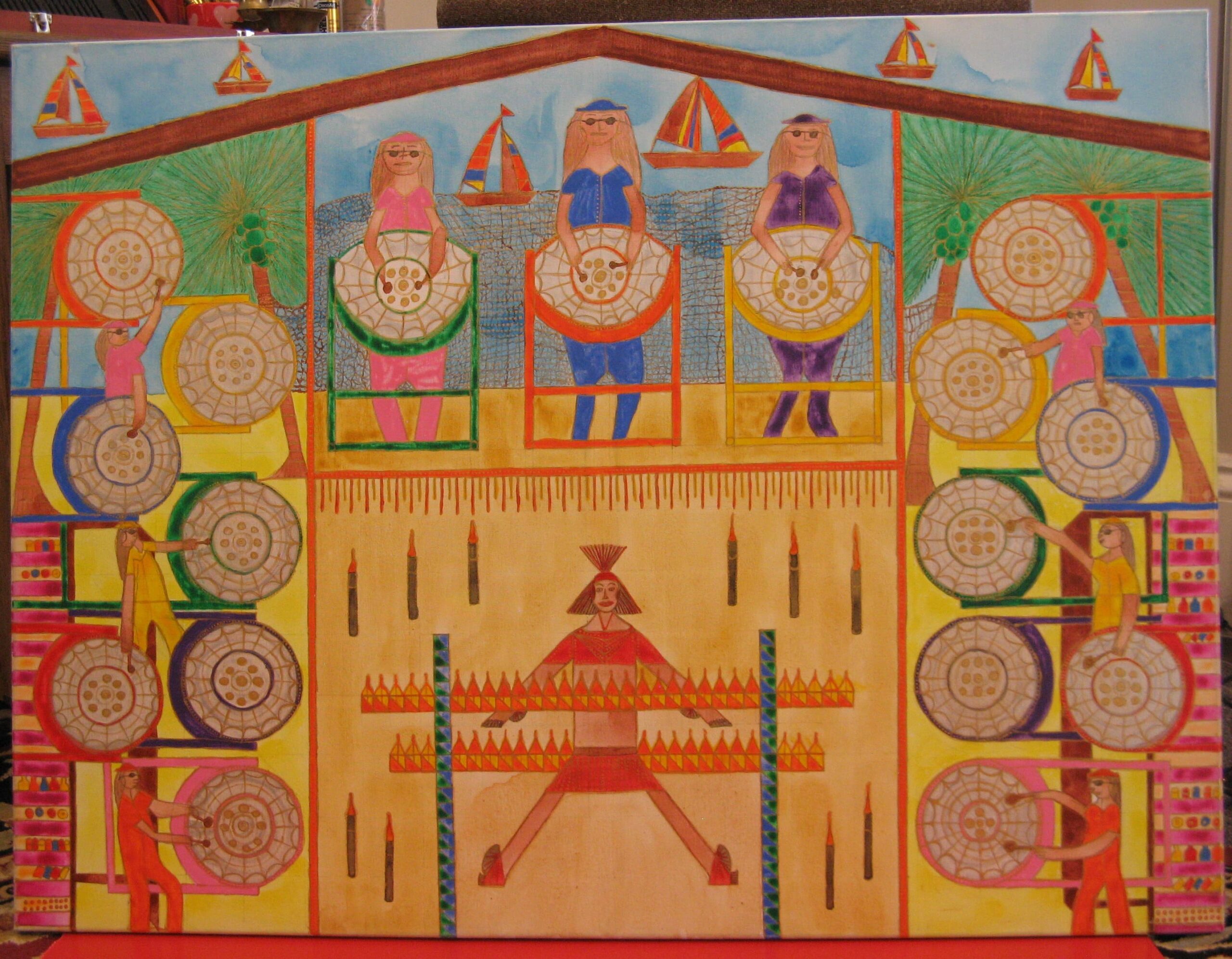
Inside “All Women Steelpan with a Limbo Dancer on Maracas Beach”
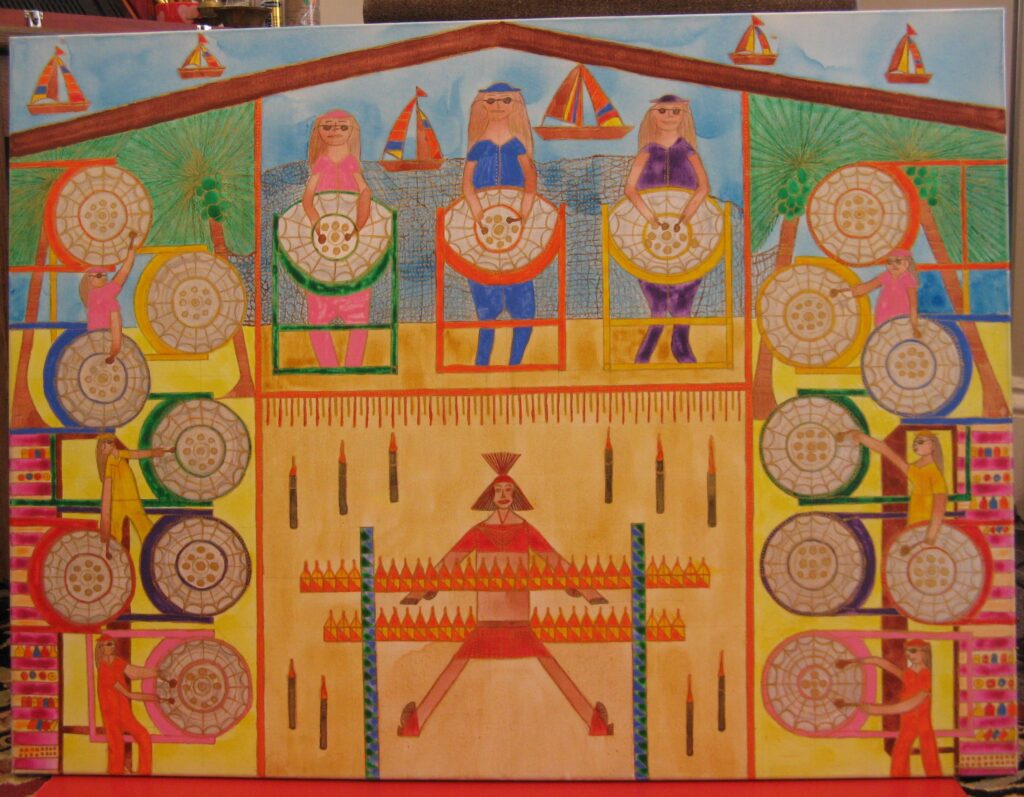
Among Indra’s most striking works is All Women Steelpan with a Limbo Dancer on Maracas Beach, Trinidad, West Indies, a painting that captures two of the islands’ most enduring cultural exports in a single frame. Steelpan, invented in Trinidad and Tobago and shaped into its modern form largely through the work of Ellie Mannette, occupies a central place in the nation’s identity. Contemporary steelpan orchestras, often dressed in coordinated jumpsuits and sunglasses, perform with instruments spanning from soprano to bass, and Indra’s painting channels that visual energy onto canvas.
The inclusion of a limbo dancer, ringed by flaming flambeau torches, adds a second layer of performance and spectacle. Limbo, long associated with Trinidadian tradition, brings physical drama into the composition, while the all-women steelpan ensemble speaks to a more contemporary current within the art form, one in which women have carved out a growing and visible role. Pan musicians across Trinidad and Tobago continue to advocate for greater recognition of the instrument, including expanded international exposure and support structures for players. Indra’s painting does not simply document a performance; it participates in that broader cultural conversation about visibility and legacy.
“The Doubles Vendor” and a Street Food’s Long History
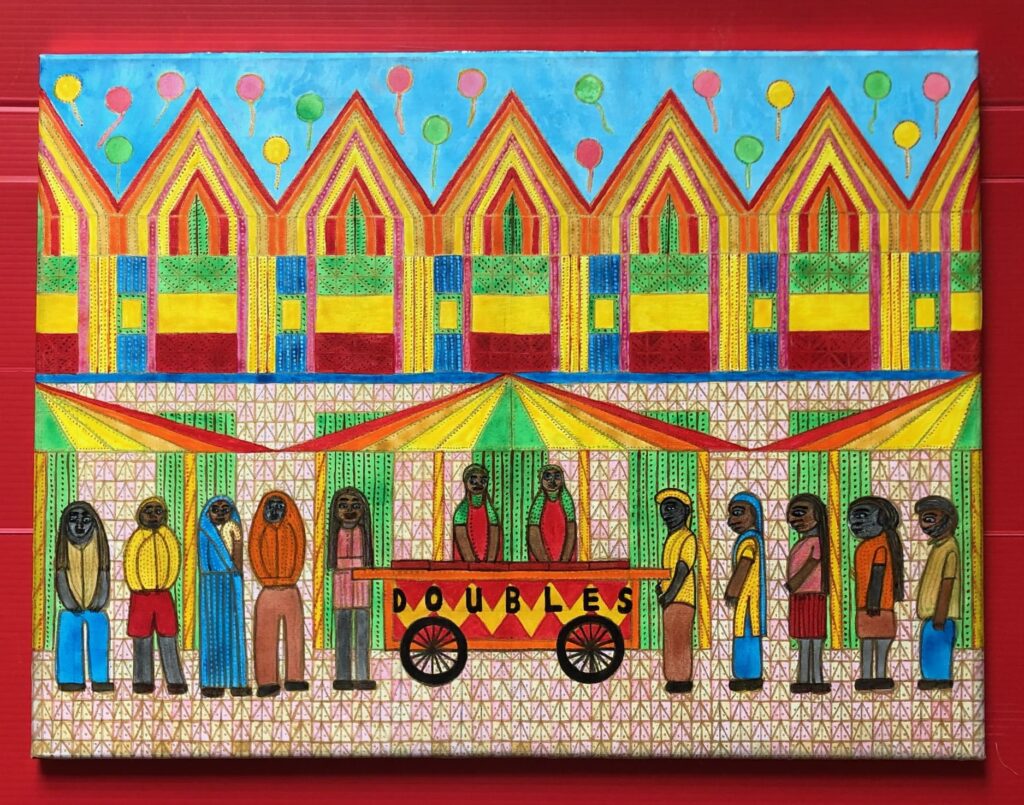
If steelpan represents Trinidad and Tobago’s sound, The Doubles Vendor represents its taste. Doubles, one of the islands’ most beloved street foods, trace their origins to 1936, when Emamool “Mamoodeen” Deen and his wife, Raheeman Rasulan Deen, began selling curried chickpeas in Princes Town. What started as a single fried flatbread evolved, at customers’ request, into two, giving the dish both its structure and its name.
Doubles carry Indo-Trinidadian roots and reflect the layered migrations that shaped the islands’ cuisine. Served with pepper sauce, kuchela, green mango, culantro, and tamarind chutney, the dish is as much about community and improvisation as it is about flavor. In painting a doubles vendor, Indra turns an everyday transaction, a familiar corner, a recognizable cart, into a meditation on memory and belonging. Food, in her hands, becomes a vessel for cultural continuity, a way of holding onto a place through the senses rather than through narrative alone.
The “Tulsi Mural” and the Language of Sacred Plants
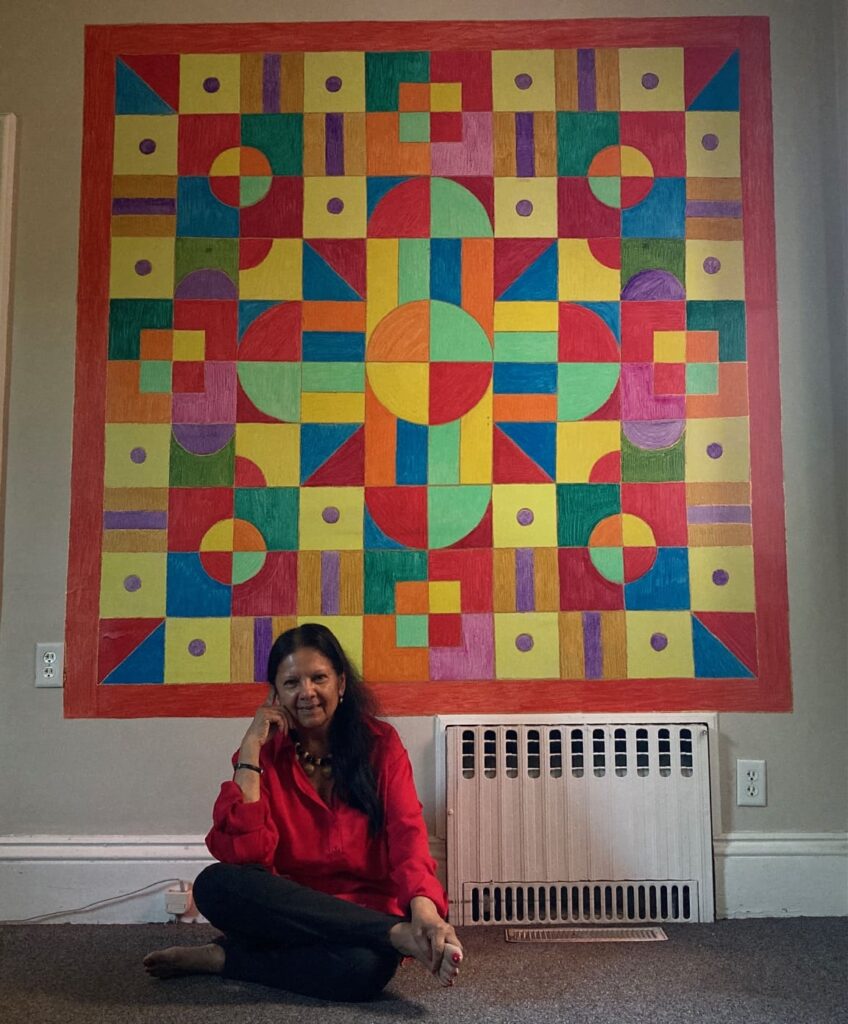
Indra’s work extends beyond canvas into public and devotional spaces, as seen in her Tulsi Mural at Tulsi Studio & Gallery. Tulsi, or holy basil, holds deep significance within Hindu culture, traditionally grown around homes and associated with purity and spiritual practice. Its connections to Lakshmi and Vishnu, along with its role in Ayurveda, give the plant a layered symbolic weight that Indra brings into visual form.
The mural reflects a different register within her practice, one oriented toward reverence rather than celebration. Where the steelpan painting captures motion and performance, the Tulsi Mural asks for stillness. Together, the three works reveal the range within Indra’s cultural storytelling, spanning festivity, everyday life, and private devotion.
Travel as an Expanding Vocabulary
Indra’s artistic language has not remained fixed to Trinidad and Tobago alone. Her collections Beautiful Ubud, Bali and My Journey to Morocco reflect a practice shaped by travel and immersion. During an Artist-in-Residence experience in Ubud, she took part in local festivals and ceremonies, absorbing traditions that expanded her visual and cultural range. These experiences did not replace her Trinidadian foundation; they added to it, giving her a comparative fluency in how different cultures express identity, spirituality, and celebration through color and ritual.
This international dimension has been matched by an equally international exhibition history. Indra’s work has been shown at the Rotunda Gallery in the Red House, Port of Spain, and at Art Impact International in Washington, D.C. In 2023, she attended a Fine Arts Conference in Singapore, an experience that further expanded her engagement with the international art community and exposed her to new perspectives within the visual arts.
Public Art and Recognition in Salem
Closer to home, Indra has become an active contributor to Salem’s public art landscape, creating murals and participating in public exhibitions that have earned recognition, including two grants from the city’s Public Art Commission. This work situates her within Salem’s own civic identity while allowing her Trinidadian sensibility to inform the visual character of the city’s public spaces. It is a quiet but meaningful reversal: an artist shaped by one place bringing that heritage to bear on another.
An Artist Who Carries Two Homes at Once
Taken together, Indra Persad Milowe’s body of work resists easy categorization. It is not simply autobiographical, nor is it purely documentary. Instead, it functions as a sustained act of cultural transmission, moving steelpan orchestras, limbo dancers, doubles vendors, and sacred tulsi plants from memory into permanence. Her paintings and murals give viewers unfamiliar with Trinidad and Tobago a genuine point of entry into its traditions, while offering those who know the islands well a recognition that feels personal.
Through decades of exhibitions, residencies, and public art projects spanning continents, Indra has built a practice defined by persistence and clarity of purpose. Her work insists that cultural memory, however specific to one place and one childhood, can travel, resonate, and belong anywhere it is seen.
To discover more about Indra Persad Milowe and view her body of work, visit IndraPersadMilowe.com