



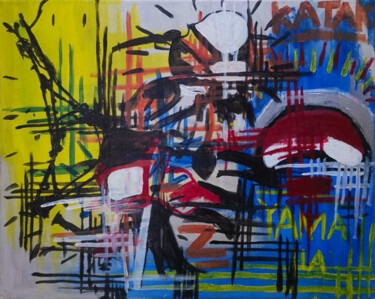
Faris Rozlin is a Malaysian artist whose relationship with painting and drawing began at a very young age. For him, drawing has always been an inseparable part of life, much like a beach and the sea that naturally exist alongside one another. Beginning his artistic journey seriously at the age of seven, Faris initially developed his skills through cartoons and comics before gradually expanding his practice into abstract and expressionist art.
Over the years, his creative language has evolved from early figurative interests toward more experimental and emotionally driven compositions. Influenced by artists such as Jean-Michel Basquiat and Robert Rauschenberg, Faris explores the possibilities of contemporary expression through vibrant colors, mixed media, and collage.
Working primarily with acrylic paint on surfaces including canvas and paper, he creates dynamic artworks that reflect his surroundings, personal experiences, and observations of cultural and social life. Through his energetic compositions, Faris continues to develop an individual voice within contemporary abstract art.
A Lifelong Relationship With Drawing
For Faris Rozlin, art began as a natural part of childhood. His passion for drawing developed at an early age, eventually becoming something he could not imagine separating from his everyday life.
He describes his relationship with drawing as inseparable, comparing it to the connection between a beach and the sea. This metaphor reflects the deeply integrated role that creativity plays in his life.
Beginning seriously at the age of seven, Faris initially concentrated on cartoons and comics. These early interests provided him with an opportunity to develop his drawing abilities while learning how images could communicate stories, characters, and emotions.
Like many artists who begin by drawing familiar subjects, Faris used these early experiences as a foundation for developing his technical skills. He continued working to improve year after year, gradually discovering new ways to approach art and express himself.
From Cartoons and Comics to Abstraction
While cartoons and comics formed an important part of Faris’s early artistic development, his practice eventually moved in a more experimental direction.
Over time, he became increasingly interested in abstract and expressionist art. This transition allowed him to move beyond the literal depiction of recognizable subjects and explore ideas through color, texture, composition, and gesture.
The shift toward abstraction also gave Faris greater freedom to express personal experiences and emotions.
Instead of relying on a clearly defined image or narrative, his paintings can communicate through the relationships between different visual elements. Colors interact with one another, shapes create movement, and layered surfaces suggest stories that viewers can interpret in their own ways.
His evolution demonstrates an ongoing willingness to challenge his own artistic habits and explore unfamiliar territory.
Inspired by Basquiat and Rauschenberg
Faris Rozlin draws inspiration from artists such as Jean-Michel Basquiat and Robert Rauschenberg, whose practices demonstrate the possibilities of combining contemporary expression with mixed media.
Basquiat’s energetic visual language and interest in cultural and social themes offer an example of how personal experience can become part of an artist’s visual vocabulary.
Rauschenberg, meanwhile, is known for challenging traditional boundaries between painting and other forms of artistic production. His use of found materials and collage demonstrated how everyday objects and images could become part of a contemporary artwork.
These influences resonate with Faris’s own interest in combining different materials and visual approaches.
Rather than treating painting as a limited or fixed medium, he approaches it as an open field for experimentation. Acrylic paint, collage elements, paper, and canvas can all become components of a single artistic conversation.
The Energy of Acrylic Paint
Acrylic is one of the primary materials used in Faris’s practice.
The versatility of acrylic paint allows him to work quickly and experiment with layers, colors, and textures. Its flexibility makes it well suited to an expressive approach in which the artist responds intuitively to the developing composition.
Faris works with acrylic on different surfaces, including canvas and paper. Each surface provides a different experience, influencing the way paint behaves and how the final artwork is perceived.
The combination of vibrant color and energetic application contributes to the dynamic character of his paintings.
Rather than allowing the medium to dictate the final result, Faris uses acrylic as a tool for exploring his ideas and emotions.
The Possibilities of Collage
Collage is another important element within Faris’s artistic practice.
By incorporating collage elements into some of his works, he introduces additional layers of meaning and texture.
Collage allows different images, materials, and fragments to coexist within a single composition. These elements can create visual contrasts or unexpected connections, encouraging viewers to consider how separate pieces relate to one another.
For an artist interested in cultural and social themes, collage can also provide an effective way to bring together different references and perspectives.
The technique complements Faris’s abstract approach by allowing his paintings to develop organically through layers of imagery, paint, and material.
Art Rooted in Personal Experience
Personal experience is an important source of inspiration for Faris Rozlin.
His artworks often reflect his observations, emotions, and responses to the environments in which he lives.
Rather than creating art in isolation, he draws from the world around him. Experiences become visual ideas, while emotions can emerge through color, texture, and composition.
This connection between life and art gives his work an authentic quality.
The abstract nature of his paintings does not mean that they lack meaning. Instead, the meaning may be expressed indirectly through the emotional energy of the composition.
A particular combination of colors or a repeated mark can carry personal significance, even when the viewer does not immediately know the story behind it.
Cultural and Social Influences
Faris’s work also engages with cultural and social aspects of Malaysia.
His surroundings provide a rich source of ideas, from everyday experiences to broader observations about society and culture.
These influences may appear in his work through symbols, colors, visual references, or the emotional atmosphere of a composition.
By incorporating aspects of his environment into an abstract visual language, Faris creates paintings that connect personal experience with wider cultural contexts.
His work demonstrates how abstraction can still engage with real-world issues. The absence of literal representation does not remove the connection to society; instead, it allows the artist to approach cultural and social themes through emotion and interpretation.
Vibrant and Dynamic Compositions
One of the most distinctive qualities of Faris Rozlin’s artwork is its energy.
His vibrant compositions create a sense of movement across the surface. Colors interact dynamically, while layered elements and expressive marks contribute to the overall rhythm of the work.
This visual energy reflects his approach to expressionism, where the physical act of creating can become part of the meaning.
The movement of the brush, the placement of color, and the layering of collage elements all contribute to the final composition.
The viewer is encouraged to move through the painting visually, discovering different details and relationships as they spend more time with the work.
Developing a Unique Artistic Voice
Faris Rozlin’s artistic journey reflects a continuous process of growth and experimentation.
From his early fascination with cartoons and comics to his current engagement with abstraction and expressionism, his practice has evolved alongside his understanding of art.
His influences provide important reference points, but his work remains grounded in his own experiences and surroundings.
By combining acrylic painting, collage, and mixed media techniques, he has created a practice that allows him to explore ideas in flexible and personal ways.
His continued experimentation demonstrates an artist who is not interested in remaining within a fixed style. Instead, he embraces the possibility of change and allows his artistic language to evolve naturally.
Art as a Reflection of Life
At the heart of Faris Rozlin’s practice is a belief in the close relationship between art and life.
Drawing has been part of his journey since childhood, and painting has become a way to process the experiences, emotions, and cultural influences that shape his world.
His abstract and expressionist works transform these experiences into vibrant compositions that communicate through color, texture, and movement.
The stories within his paintings may not always be immediately visible, but they remain present in the layers of paint, collage, and expressive marks.
Ultimately, Faris Rozlin’s artistic journey is one of continuous exploration. From his childhood beginnings in cartoons and comics to his contemporary practice rooted in abstraction, he has remained committed to discovering new ways of expressing himself.
Through acrylic, collage, and mixed media, he creates dynamic artworks that reflect personal experience while engaging with broader cultural and social ideas. His vibrant compositions demonstrate the power of abstraction to communicate emotion, memory, and identity without relying on literal representation.
As his practice continues to evolve, Faris Rozlin is developing a distinctive place within contemporary abstract art. His work reflects both the influence of his surroundings and his desire to create something uniquely his own—a visual language where color, material, movement, and personal experience come together to tell stories that remain open to interpretation.