



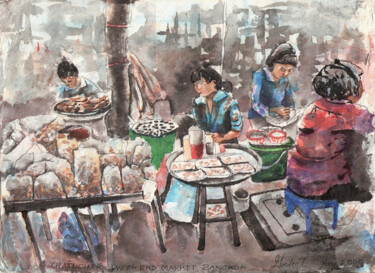
Gordon T. is a Canadian artist who has maintained a professional artistic practice since 1980. A self-taught painter raised in a family of amateur artists, Gordon developed his creative interests from an early age, exploring different forms of visual expression before eventually dedicating himself to painting.
Over the course of his artistic career, Gordon’s work has undergone a significant evolution. His early approach was more illustrative, while his later practice gradually moved toward bold expressionism and abstraction. Throughout this transformation, however, several ideas have remained central to his creative process: movement, expressive brushwork, color, and the search for a composition that feels complete and balanced in itself.
Working primarily with acrylics on thick paper and occasionally creating graphite sketches on smooth paper, Gordon approaches each artwork as an exploration of visual energy. His paintings are not simply concerned with depicting a subject but with capturing the movement and emotional force that exist within it.
A Self-Taught Artistic Journey
Gordon’s artistic development began within a family of amateur artists, where creativity was part of his early environment. This background gave him an initial connection to art and encouraged him to explore different forms of visual expression.
Before committing himself fully to painting, he participated in workshops covering art, sketching, photography, and film. These experiences exposed him to different ways of observing and interpreting the world.
Sketching taught him to pay attention to line and structure, while photography offered another way of considering composition, light, and perspective. His exposure to film also introduced him to ideas of movement and visual storytelling.
Although Gordon eventually focused on painting, these early experiences became part of the foundation of his artistic practice. They contributed to a broader understanding of how images can communicate ideas and emotions.
His path as a self-taught artist has allowed him to develop his creative language through personal experimentation and continuous exploration.
From Illustration to Expressionism
Over the years, Gordon’s artistic style has evolved considerably. His earlier work was more illustrative, reflecting an interest in recognizable subjects and visual representation.
As his practice developed, however, he increasingly moved toward bold expressionism and abstraction.
This transition reflects a growing interest in the emotional and physical qualities of painting itself. Instead of focusing primarily on accurately representing what he sees, Gordon became more interested in how a subject could be transformed through movement, color, and brushwork.
Expressionism provided him with a way to communicate energy and emotion more directly. Through strong marks and dynamic compositions, he could explore the feeling behind a subject rather than simply presenting its outward appearance.
His movement toward abstraction took this exploration further, allowing forms and colors to exist more independently from literal representation.
The Search for Movement
Movement is one of the most important elements in Gordon’s artistic practice. His paintings often seek to create a sense of visual energy, encouraging the viewer’s eye to travel through the composition.
This movement can be created through brushwork, lines, color relationships, and the arrangement of forms. Rather than allowing the eye to remain fixed in one place, Gordon creates compositions that encourage continuous visual exploration.
The idea of movement also connects his work to his early experiences with photography and film. Although painting is a static medium, he uses visual elements to suggest motion and rhythm.
A brushstroke can appear to carry energy across the surface, while contrasting colors can create tension and movement between different areas of the composition.
This gives his paintings a dynamic quality, even when the subject itself may appear still.
Expressive Brushwork
Gordon’s approach to brushwork is closely connected to his interest in movement. His marks are not merely technical tools for applying paint; they become expressive elements within the artwork.
The direction, intensity, and rhythm of a brushstroke can influence how a viewer experiences the entire composition.
Bold marks can create a sense of confidence and energy, while more subtle gestures can introduce moments of calm or reflection.
Through expressive brushwork, Gordon allows the physical act of painting to remain visible in the finished work. The viewer can sense the movement involved in its creation, creating a direct connection between the artist’s actions and the final image.
This emphasis on the gesture of painting is particularly important in his expressionistic and abstract work, where the brushstroke itself can become part of the subject.
The Power of Color
Color plays a central role in Gordon’s visual language. His exploration of color is closely connected to his interest in movement and expression.
Rather than using color only to reproduce the appearance of the physical world, he treats it as an independent expressive force.
Colors can create visual rhythm, establish relationships between different parts of the canvas, and influence the emotional atmosphere of the work.
The interaction between colors can also contribute to the sense of movement that Gordon seeks. Contrasting tones may create tension, while related colors can establish harmony and continuity.
Through this approach, color becomes a way of organizing the composition while simultaneously communicating emotion.
Acrylic on Thick Paper
Gordon works primarily with acrylics on thick paper. This medium provides him with a versatile surface for exploring bold color and expressive mark-making.
Acrylic paint is particularly well suited to his dynamic approach. It can be applied in layers, used with different degrees of opacity, and manipulated through a variety of techniques.
Working on thick paper also gives his paintings a distinctive physical quality. The surface provides a foundation for expressive brushwork while allowing the artwork to retain a sense of immediacy.
The relationship between medium and surface is an important part of his creative process. The materials support his desire to create works that feel energetic and direct.
Graphite and the Importance of Sketching
Although painting is central to Gordon’s artistic practice, sketching also remains an important part of his creative language.
He often works with graphite on smooth paper, creating sketches that focus on line, form, and observation.
Graphite offers a contrast to the boldness of his acrylic paintings. Its monochromatic nature encourages attention to structure and detail, while the simplicity of the medium allows Gordon to explore ideas in a more immediate way.
These sketches can be understood as another expression of his interest in movement. Even without color, the direction and quality of a line can suggest energy and rhythm.
The relationship between his graphite sketches and his paintings demonstrates the breadth of his artistic practice, connecting careful observation with expressive abstraction.
Composition as a State of Balance
For Gordon, an artwork reaches completion when its composition feels balanced onto itself.
This idea is central to his understanding of when a painting is finished. Rather than relying solely on a predetermined set of rules, he responds to the relationships between the different elements within the work.
Color, movement, brushwork, and form must work together to create a sense of visual equilibrium.
This does not necessarily mean that his compositions are symmetrical or static. Instead, balance can emerge through contrast and tension.
A bold area of color may be balanced by a quieter section, while a strong directional brushstroke may be countered by another visual element elsewhere in the composition.
The result is a dynamic form of balance in which every part contributes to the overall integrity of the work.
Knowing When a Painting Is Complete
The question of when an artwork is finished is an important part of Gordon’s philosophy.
For him, completion occurs when the different elements of a composition reach a natural equilibrium. The work feels complete not because every available space has been filled, but because the relationships between the elements have become resolved.
This approach reflects his broader interest in movement and expression. A painting can remain energetic and dynamic while still feeling balanced.
The moment of completion is therefore less about stopping the creative process and more about recognizing when the artwork has achieved its own internal logic.
A Message of Movement and Balance
Gordon T.’s artistic journey reflects a continuous exploration of how painting can communicate energy and emotion. From his early illustrative work to his development into expressionism and abstraction, his practice has remained focused on discovering new ways to create movement and visual connection.
His use of acrylic on thick paper allows him to work with bold colors and expressive brushwork, while his graphite sketches offer a quieter exploration of line and form.
Across these different approaches, his central concerns remain consistent. He seeks movement within the composition, expressive energy within the brushwork, and a sense of balance that allows each work to stand independently.
Ultimately, Gordon’s artistic philosophy is rooted in the belief that a successful artwork should contain its own sense of resolution. When movement, color, brushwork, and composition come together naturally, the painting reaches its moment of completion.
Through his decades-long professional practice, Gordon T. continues to explore the possibilities of painting as a language of movement and expression. His work demonstrates how an artist can evolve from illustration toward abstraction while maintaining a clear commitment to the fundamental elements that make painting powerful: gesture, color, emotion, and balance.