



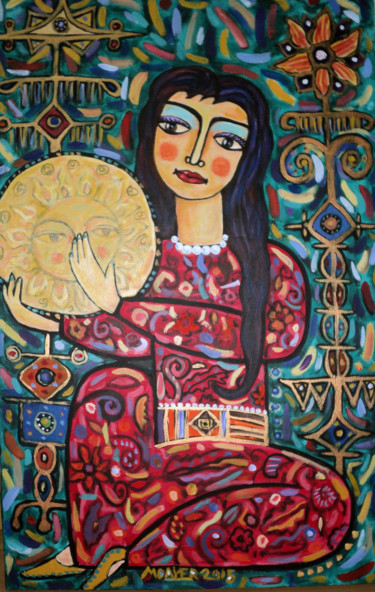
Reza Moayer Toroghi, known as Bahador, is an accomplished artist, educator, and researcher whose multidisciplinary practice encompasses painting and graphic arts. With an academic background spanning painting, graphic design, environmental studies, cinema, photography, and educational sciences, Bahador has developed a broad creative perspective that connects visual art with cultural heritage, symbolism, and the environment.
His artistic practice primarily focuses on acrylic painting on canvas, where he explores figurative and symbolic imagery through vibrant colors, intricate patterns, and carefully developed compositions. Drawing from cultural and environmental themes, Bahador has created a distinctive visual language that brings traditional symbolism into conversation with contemporary artistic expression.
His career extends beyond his personal studio practice. Over the years, he has exhibited his work internationally, contributed to art education as a professor and academic administrator, and founded an animation studio. His research into Iranian artistic symbolism and environmental design has further enriched his creative approach, providing an intellectual foundation for his exploration of visual culture.
A Multidisciplinary Artistic Foundation
Bahador’s artistic journey is supported by an extensive educational background.
He holds a PhD in Environment Built from IIUM University, an M.A. in Graphic Arts from Tehran University, and a B.A. in Painting from Tehran University of Art.
His studies have also extended into educational sciences, cinema direction, and photography.
This broad range of academic interests has allowed Bahador to approach art from multiple perspectives.
His background in painting provides a foundation in traditional artistic practice, while his studies in graphic arts have contributed to his understanding of composition, visual communication, and design.
His interest in photography and cinema has further expanded his awareness of image-making, perspective, storytelling, and visual narrative.
Meanwhile, his academic work in the built environment has connected his creative thinking to questions surrounding space, culture, and the relationship between people and their surroundings.
Together, these experiences have contributed to a practice that extends beyond a single artistic discipline.
Acrylic Painting as a Primary Medium
Acrylic painting on canvas is central to Bahador’s artistic practice.
The medium offers him considerable flexibility, allowing him to work with layers of color, intricate patterns, and expressive forms.
His paintings often demonstrate a strong interest in vibrant color.
Rather than treating color simply as a tool for realistic representation, Bahador uses it as an important expressive element within his compositions.
Bright and varied tones can create visual energy, while the relationships between colors help establish rhythm and movement across the canvas.
His approach to acrylic painting also allows him to combine figurative imagery with symbolic elements, creating works that operate on multiple visual and conceptual levels.
Figurative and Symbolic Expression
One of the defining characteristics of Bahador’s work is the combination of figurative and symbolic approaches.
His paintings often contain recognizable forms while simultaneously incorporating imagery that carries deeper cultural or conceptual meanings.
This allows viewers to engage with his work on different levels.
At first glance, the vibrant colors and detailed patterns create an immediate visual impact.
With closer attention, however, the symbolic qualities of the compositions become more apparent.
Bahador’s interest in symbolism reflects his broader engagement with cultural history and artistic traditions.
Rather than reproducing traditional symbols in a purely historical context, he reinterprets them through a contemporary visual language.
This creates a bridge between the past and present, allowing familiar cultural ideas to take on new meanings within modern painting.
The Influence of Cultural Heritage
Cultural heritage is an important foundation within Bahador’s artistic thinking.
His research interests include magic symbols in Iranian art, as well as the use and meaning of symbolic imagery.
These areas of study have informed his creative work and contributed to the development of his visual vocabulary.
Symbolism can provide an artist with a way to communicate ideas that extend beyond literal representation.
A single image, pattern, or motif can carry layers of historical, spiritual, or cultural meaning.
Bahador’s work demonstrates an interest in this complexity.
By incorporating symbolic references into contemporary compositions, he creates artworks that connect visual beauty with cultural memory.
His approach reflects a desire to preserve the significance of traditional imagery while allowing it to evolve within a modern artistic context.
Exploring Environmental Themes
Bahador’s academic and artistic interests also extend to the environment.
His research into environmental design has influenced his understanding of the relationship between people, spaces, and the natural world.
This interest creates another dimension within his artistic practice.
The environment can be understood not only as a physical space but also as a cultural and symbolic landscape.
Through his art and research, Bahador explores how visual expression can respond to the spaces people inhabit and the relationship between human activity and the world around it.
This engagement with environmental ideas complements his interest in cultural symbolism, creating a practice that connects heritage with contemporary questions about place and environment.
The Symbolism of the Sun
Among Bahador’s research interests is the study of sun symbols.
The sun has held powerful symbolic significance across many cultures and artistic traditions.
It can represent light, life, energy, renewal, and transformation.
By researching the role of sun symbolism, Bahador examines how visual motifs can communicate complex ideas across time and culture.
This research informs his broader interest in symbolic art and contributes to his exploration of how traditional imagery can be incorporated into contemporary visual expression.
His artistic practice demonstrates that symbols can remain relevant even as their contexts change.
When placed within new compositions, they can invite viewers to reconsider familiar imagery and discover alternative interpretations.
A Career Across Art and Education
Bahador’s contribution to the art world extends beyond his own paintings.
Throughout his career, he has worked as a professor and held management positions within art departments at various universities.
These roles reflect his commitment to education and the development of future generations of artists.
Teaching provides an opportunity to share technical knowledge, artistic ideas, and critical perspectives with students.
For an artist with such a diverse educational background, academic work also creates a space where different disciplines can interact.
Painting, graphic arts, photography, cinema, and environmental studies can all contribute to a broader understanding of visual culture.
Through his educational activities, Bahador has therefore contributed to the artistic community not only as a practicing artist but also as a mentor and academic.
Founding an Animation Studio
Bahador’s creative interests also extend into animation.
His role in founding an animation studio demonstrates his willingness to explore artistic disciplines beyond traditional painting.
Animation combines elements of drawing, design, storytelling, movement, and technology.
For an artist already interested in graphic arts, cinema, and visual communication, animation offers a natural extension of these interests.
This aspect of his career further illustrates the multidisciplinary character of his practice.
Rather than viewing artistic disciplines as separate categories, Bahador’s career reflects an understanding of their connections.
Painting can inform graphic design. Photography can influence visual composition. Cinema can shape storytelling. Animation can transform static imagery into movement.
These relationships contribute to the breadth of his creative perspective.
International Exhibitions and Recognition
Bahador has presented his work through numerous solo and group exhibitions across different countries and cultural contexts.
His exhibitions have taken place in Iran, Turkey, the United States, Italy, Spain, and Malaysia.
This international presence has allowed his work to reach audiences with different cultural backgrounds and artistic perspectives.
Exhibiting internationally can also provide an artist with opportunities to engage in conversations that extend beyond national or regional boundaries.
For Bahador, whose practice already explores the relationship between traditional symbolism and contemporary expression, these international contexts provide an important platform for dialogue.
His artistic achievements have also been recognized through multiple honors, while his involvement with several art associations reflects his continued engagement with the wider professional art community.
A Visual Language of Color and Pattern
Color and pattern are central to the visual impact of Bahador’s paintings.
His intricate compositions demonstrate an interest in the decorative and expressive possibilities of repeated forms.
Patterns can create rhythm within an artwork, guiding the viewer’s eye across the surface.
They can also contribute to the symbolic meaning of a composition, particularly when connected to cultural traditions.
Combined with vibrant colors, these patterns create paintings that are visually rich and engaging.
The resulting works demonstrate how decorative elements can coexist with deeper conceptual ideas.
The visual beauty of the paintings provides an entry point, while the symbolic and cultural references encourage viewers to look more closely.
Tradition and Contemporary Art
A key aspect of Bahador’s artistic identity is his ability to connect tradition with contemporary expression.
His research into Iranian symbols and cultural imagery provides a foundation rooted in history.
At the same time, his use of acrylic paint, modern compositions, and contemporary approaches to color and form places his work firmly within a modern artistic context.
This combination allows his paintings to exist between different worlds.
They are informed by the past but not confined by it.
Instead, traditional symbols are reimagined and incorporated into compositions that speak to contemporary audiences.
This process of reinterpretation is central to Bahador’s artistic contribution.
An Evolving Artistic Journey
Beginning his artistic career in the late 1980s, Bahador has maintained a sustained commitment to creative practice, research, and education.
Over the decades, his career has continued to evolve across multiple disciplines and cultural environments.
His work demonstrates that an artist’s development can extend far beyond the studio.
Academic research, teaching, graphic arts, environmental studies, photography, cinema, and animation have all contributed to his understanding of visual expression.
This broad perspective has helped him develop a practice that is both intellectually engaged and visually distinctive.
The Continuing Dialogue Between Art and Culture
Ultimately, Reza Moayer Toroghi, known as Bahador, represents an artistic practice built around exploration and connection.
His paintings combine vibrant color, intricate patterns, figurative imagery, and symbolism to create works that engage with cultural and environmental ideas.
His extensive education and multidisciplinary interests have allowed him to approach art from a variety of perspectives, while his research into symbolism has strengthened the conceptual foundations of his creative work.
At the same time, his international exhibitions, academic positions, and contributions to the arts community demonstrate a career dedicated not only to creating art but also to sharing knowledge and encouraging artistic development.
Through his paintings and broader creative activities, Bahador continues to explore how traditional cultural symbols can be transformed through contemporary artistic expression. His work stands as an ongoing conversation between history and modernity, symbolism and visual experimentation, and individual creativity and collective cultural memory.