



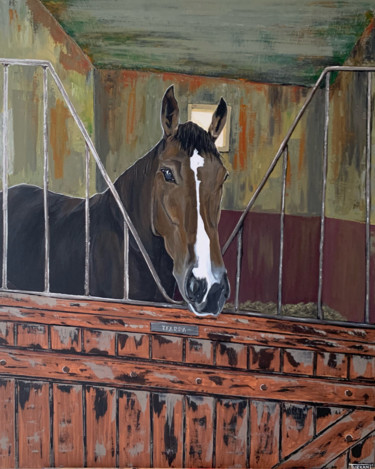
Turkan is an artist whose creative practice centers on painting, with a particular focus on oil and acrylic works created on canvas. Her artistic approach combines traditional painting techniques with an interest in texture, color, and material experimentation, allowing her to create vivid compositions with a strong visual presence.
Working across figurative and representational subjects, Turkan explores themes through portraits and animal imagery. Her paintings demonstrate careful attention to detail and texture, while her use of different tools and materials enables her to achieve a variety of visual effects.
From expressive palette knife applications to more controlled brushwork, Turkan approaches each composition with an openness to experimentation. Her occasional use of metallic acrylic paints adds another dimension to her work, introducing reflective qualities that interact with surrounding colors and textures.
A Practice Rooted in Painting
Painting is at the center of Turkan’s artistic practice.
Her work reflects a continued engagement with traditional mediums, particularly oil and acrylic paints on canvas. These materials provide her with a versatile foundation for exploring both realistic and expressive approaches to art.
Through painting, Turkan focuses on subjects that can communicate through form, color, and detail. Her figurative compositions often invite viewers to look closely at the relationships between the subject and the surface of the canvas.
Rather than limiting herself to a single technique, she explores different approaches depending on the visual qualities she wants to achieve.
This willingness to experiment has become an important part of her artistic development.
Exploring Oil and Acrylic
Oil and acrylic paints form the foundation of Turkan’s artistic vocabulary.
Each medium offers different possibilities, and her practice demonstrates an appreciation for the distinctive qualities of both.
Oil paint allows for rich textures, gradual transitions, and layered color. It can be used to create subtle details and depth, making it particularly effective for figurative subjects and portraits.
Acrylic paint offers a different experience, often allowing for more direct and dynamic applications. Its versatility makes it suitable for experimentation with texture, layering, and bold color.
By working with both mediums, Turkan can explore different aspects of her artistic vision.
Her choice of materials becomes part of the creative process, allowing the medium itself to influence the character of each painting.
The Expressive Potential of the Palette Knife
One of the techniques Turkan incorporates into her practice is palette knife painting.
The palette knife can create strong, visible marks that add dimension and movement to a painting.
Unlike the controlled line of a traditional brush, the palette knife can produce thicker applications of paint and more pronounced textures.
For Turkan, this technique provides an opportunity to explore the physical qualities of paint.
The resulting textures can enhance the appearance of a subject, creating surfaces that feel dynamic and tactile.
Palette knife work can also introduce a sense of spontaneity into a composition, allowing the artist to balance carefully rendered details with more expressive marks.
The Precision of Brushwork
Alongside palette knives, Turkan also works with brushes.
Brushwork allows her to approach her subjects with greater precision, particularly when focusing on details within portraits and animal imagery.
The combination of brushes and palette knives gives her a broad range of possibilities.
Some areas of a painting may feature carefully controlled details, while others may be defined by thicker and more expressive applications of paint.
This contrast creates visual variety and allows the viewer’s attention to move across the composition.
The relationship between precise brushwork and textured palette knife applications contributes to the distinctive character of Turkan’s paintings.
A Focus on Portraiture
Portraiture is an important part of Turkan’s figurative practice.
The portrait offers an opportunity to explore the human subject through expression, form, color, and texture.
Turkan’s attention to detail allows her to focus on the distinctive qualities of her subjects while also experimenting with the possibilities of paint.
Her use of oil and acrylic enables her to build layers and develop visual depth, while different application techniques contribute to the overall atmosphere of each composition.
Through portraiture, she demonstrates an interest in representing the individual while maintaining an expressive relationship with the medium itself.
Animals as Artistic Subjects
In addition to portraits, Turkan’s work includes animal subjects.
Animals provide an opportunity to explore different forms, textures, and visual characteristics.
Fur, feathers, skin, and other natural surfaces can be interpreted through variations in brushwork and paint application.
These subjects also allow Turkan to experiment with the balance between realistic representation and expressive technique.
The careful rendering of an animal can exist alongside more dynamic textures and colors, creating a painting that is both recognizable and visually engaging.
Her animal paintings demonstrate her ability to adapt her techniques to different subjects while maintaining a consistent interest in detail and texture.
The Importance of Texture
Texture plays a significant role in Turkan’s artistic approach.
By using different tools and methods, she creates surfaces that encourage viewers to engage with the physical qualities of the painting.
Thicker layers of paint can create a sense of depth, while smoother areas provide contrast.
This variation prevents the canvas from becoming visually uniform.
Instead, the surface becomes an active part of the artwork, contributing to its overall mood and character.
Texture can also enhance the realism of figurative subjects while simultaneously emphasizing the fact that the image has been created through paint.
This balance between representation and materiality is an important feature of Turkan’s practice.
Experimenting With Metallic Color
In some of her paintings, Turkan incorporates metallic acrylic paints.
These materials introduce reflective qualities that can change depending on the surrounding light and the viewer’s position.
Metallic elements can add a sense of luminosity and visual depth to a composition.
They also provide an interesting contrast with traditional oil and acrylic colors.
The use of metallic paint demonstrates Turkan’s willingness to explore beyond conventional approaches to color.
Rather than relying exclusively on standard pigments, she experiments with materials that can alter the way a painting interacts with light.
This creates another layer of visual interest within her work.
Color as a Source of Expression
Color is an essential part of Turkan’s artistic language.
Her use of oil, acrylic, and metallic paints allows her to explore a wide range of color relationships.
Vivid tones can create energy and intensity, while more subtle combinations can establish atmosphere and depth.
Color also works alongside texture to influence how viewers experience her paintings.
A thick application of bright paint can create a strong focal point, while softer tones may allow other areas of the composition to recede.
Through these choices, Turkan demonstrates how color can function as both a descriptive and expressive element.
Balancing Realism and Artistic Interpretation
Turkan’s work occupies a space between representation and personal artistic interpretation.
Her portraits and animal paintings are grounded in recognizable subjects, yet her use of texture, color, and varied techniques gives them a distinctive artistic character.
The goal is not simply to reproduce a subject exactly.
Instead, Turkan uses the visual language of painting to explore how a subject can be transformed through material and technique.
The viewer can recognize the person or animal being portrayed while also experiencing the expressive qualities of the paint itself.
This balance allows her work to remain accessible while maintaining a strong sense of artistic individuality.
A Continuous Exploration of Technique
Turkan’s artistic practice reflects an ongoing interest in discovering what oil and acrylic painting can achieve.
Her use of brushes, palette knives, and metallic acrylics demonstrates a willingness to experiment with different approaches.
Each technique offers a different way of interacting with the canvas.
The brush allows for precision and detail. The palette knife introduces texture and movement. Metallic pigments create reflective surfaces and new relationships with light.
By combining these possibilities, Turkan continues to develop a flexible and evolving visual language.
Developing a Distinctive Style
Through her commitment to experimentation, Turkan has developed a distinctive approach to figurative and representational painting.
Her work combines attention to detail with expressive textures, bringing together traditional painting methods and contemporary experimentation.
The subjects she chooses—particularly portraits and animals—provide a foundation for exploring form and character, while her use of materials gives each composition its own visual identity.
Her artistic style is therefore shaped not only by what she paints but also by how she applies the paint.
This relationship between subject, medium, and technique remains central to her practice.
The Possibilities of Paint
Ultimately, Turkan’s work reflects a deep engagement with the possibilities of painting.
Through oil and acrylic on canvas, she explores how traditional mediums can be used in varied and contemporary ways.
Her portraits and animal subjects demonstrate an appreciation for observation and detail, while her use of palette knives, brushes, layered textures, and metallic colors introduces a more experimental dimension.
Her paintings invite viewers to appreciate both the subject and the process behind its creation.
The recognizable forms provide an immediate connection, while the textures, colors, and material qualities encourage closer examination.
By bringing together realism, expressive technique, and experimentation, Turkan continues to develop a visual language that is both dynamic and personal. Her practice demonstrates how the traditional art of painting can remain open to innovation, with every brushstroke, layer, and textured surface offering another opportunity to explore color, emotion, and visual expression.